
Joint support for high-impact dog sports: care and training
Joint support for high-impact dog sports starts with managing impact, not simply adding more exercise. Articular cartilage and joint fluid help reduce friction and absorb force from hard landings, while thoughtful training adjustments can limit repeated strain. Puppies and adolescent large- and giant-breed dogs that are still developing should avoid high-impact sports.
When your dog loves to compete, it’s natural to focus on speed, jumps, and performance. But limping, stiffness, reluctance to move, or difficulty getting up can signal that exercise is taking a toll and needs attention.
Learn how demanding activities affect joints, which changes may point to pain, and why avoiding all movement isn’t the answer. This guide covers safer training adjustments alongside veterinary care, rehabilitation, weight management, and nutrition, so you can support your dog’s comfort and keep activity purposeful.
Key Takeaways
- Hard landings and repeated jumps can load a dog’s joints; developing large- and giant-breed dogs should avoid high-impact sports.
- Watch for limping, stiffness, reluctance to move, or difficulty getting up, and seek veterinary care when these signs appear.
- Joint care can combine suitable exercise, rehabilitation, weight management, and nutrition rather than relying on supplements alone.
- Adapt training to your dog’s physical limits with controlled, lower-impact activity and gradual changes to the routine.
- Learn which joint injuries can arise in high-impact sports and how to make training safer for your dog.
High-impact activities and joint stress
Hard landings, sharp turns, and repeated jumps challenge a dog’s joints. The right activity depends on the dog’s development, comfort, and any existing joint pain.
Joint Stress in High-Impact Activities
High-impact activity creates repeated forces as a dog accelerates, turns, and lands. Articular cartilage and joint fluid help reduce friction and absorb impact, but hard landings still load the joints. This matters during agility jumps or intense fetch, where repeated movement can build strain over a session. Puppies and adolescent large- and giant-breed dogs that are still developing should avoid high-impact sports.
High-Impact Activities to Avoid
For dogs with joint pain, avoid running on hard surfaces, jumping, rough play, sharp turns, and high-intensity fetch. These movements combine impact with sudden changes in speed or direction. For example, if your dog favors one leg during fetch, switch to lower-impact activity instead of encouraging another sprint.
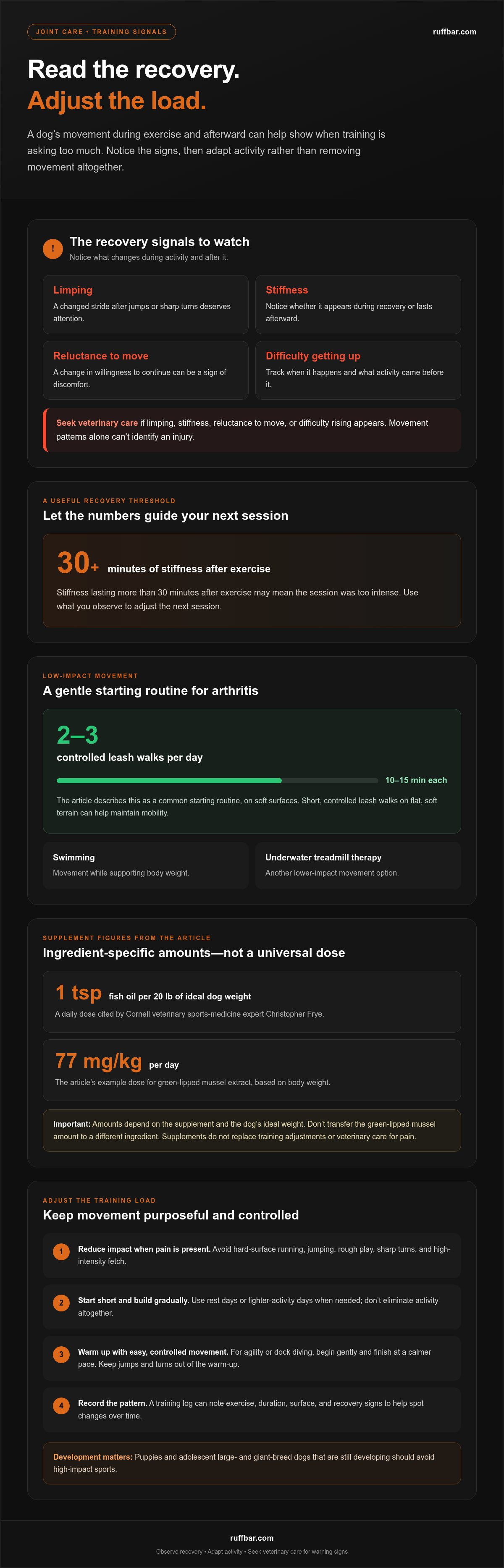
Low-impact movement can suit senior dogs better than explosive play. Short, controlled leash walks on flat, soft terrain help maintain mobility; swimming and underwater treadmill therapy allow movement while supporting body weight. For arthritis, a common starting routine is two to three controlled leash walks of 10-15 minutes per day on soft surfaces.
Common Joint Injuries in Dog Sports
Joint injuries can involve structures that stabilize the body and enable movement. Ligaments connect bone to bone, tendons connect muscle to bone, and cartilage cushions joint surfaces. A hard landing or sudden pivot can put force on these structures, so pay attention to how your dog moves after sport as well as during it.
Watch for a changed stride after jumps or sharp turns rather than assuming a limp is ordinary fatigue. Movement patterns alone can’t identify an injury, but limping, stiffness, or reluctance to move are reasons to seek veterinary care. An assessment can distinguish joint pain from other causes and guide decisions about activity.
Supplements for Highly Active Dogs
Supplements are one part of joint care, not a substitute for adjusting an activity that causes strain. Omega-3 fatty acids, including fish oil, can be considered for joint health and mobility. Cornell veterinary sports-medicine expert Christopher Frye cites a daily fish-oil dose of 1 teaspoon per 20 pounds of ideal dog weight.
How much joint supplement should a dog receive based on weight and activity level? The amount depends on the supplement and the dog’s ideal weight; activity level alone doesn’t set a universal dose. For example, the cited green-lipped mussel extract dose is 77 milligrams per kilogram of body weight per day. Don’t transfer that amount to a different ingredient.
Signs that exercise is causing pain or joint stress
A dog’s stride can show when training is asking too much. Compare movement during exercise with recovery afterward, then adjust the next session based on what you observe.
Watch for Changes During and After Exercise
Track limping, stiffness, fatigue, reluctance to move, and difficulty getting up. Note when each sign appears, such as after repeated jumps or an intense fetch session. Stiffness lasting more than 30 minutes after exercise may mean the session was too intense. Limping, stiffness, reluctance to move, or difficulty rising warrant veterinary care.
Don’t eliminate activity altogether: joints need movement to stay mobile, and the surrounding muscles need exercise. Instead, start with short sessions and increase exercise gradually. Use rest days or lighter-activity days when needed. A simple training log can note the exercise, duration, surface, and recovery signs, helping you spot patterns over time.
Build Strength and Warm Up with Control
How can conditioning and strength training reduce joint injury risk in canine sports? Stronger surrounding muscles help support movement, while gradual conditioning prepares a dog for sport-specific demands. Gentle uphill walking can build muscle if your dog is comfortable. Slow, controlled sit-to-stand movements can also build strength without excessive repetitions.
For agility or dock diving, begin with easy, controlled movement before faster work, then finish at a calmer pace. Keep turns and jumps out of the warm-up. The routine should feel comfortable and consistent, not become another high-intensity drill.
Choose Exercises That Match the Dog
AKC Obedience exercises at Beginner Novice and Novice levels are generally low impact. Some Open-level exercises include jumps that may challenge a dog’s legs. If your dog shows stiffness after jumping, discuss lower-impact options and a suitable activity plan with a veterinarian.
Veterinarian-guided range-of-motion exercises may help address joint pain, but the veterinarian should recommend the movements. Don’t force a limb through a stretch or copy a routine designed for another dog. Pair prescribed movement with short, manageable exercise and monitor your dog’s recovery after each session.
Support Joints Beyond the Training Field
Controlled, appropriate exercise supports mobility, while joint supplements may contribute to a broader care plan. They don’t replace training adjustments or veterinary care for pain. Glucosamine is present in joint cartilage, and chondroitin sulfate helps cartilage retain water and elasticity. Supplement choice and amount should suit the dog, not just the sport.
Use a steady routine, suitable nutrition, and recovery observations as connected parts of care. For active-dog nutrition, explore nutrition options for active dogs alongside a veterinarian-guided joint plan.
Joint supplements, rehabilitation, and weight management
Joint care works best as a coordinated routine, not as a supplement alone. Ingredients, rehabilitation, and body weight each affect how comfortably a dog moves. A balanced approach to joint support for high-impact dog sports considers all three.
Comparing Joint-Support Supplement Brands
Compare brands by checking ingredient amounts, testing transparency, and the cost of a labeled daily serving. This helps you assess what each formula provides without relying on broad claims or package size alone.
Start with the full ingredient panel. Glucosamine occurs naturally in joint cartilage, while chondroitin sulfate helps cartilage retain water and elasticity. Compare the stated amounts instead of assuming two products are equivalent because both list these ingredients. Look for clear information about testing methods and whether results apply to the finished product.
To compare prices, divide a package’s current price by the number of labeled daily servings. Don’t assume a lower package price means better value if serving directions differ. A supplement’s suitability also depends on your dog’s health, other ingredients, and existing routine, not just cost.
Supplement Safety and Ingredients to Avoid
A safe choice is one whose ingredients and directions fit the individual dog’s health needs. There isn’t one universal list of ingredients to avoid for every dog: risks depend on the ingredient, dose, health conditions, and medications.
Review the complete label with your veterinarian before adding a supplement, especially if your dog takes medication or has a diagnosed condition. Ask about each active ingredient and its intended role. Some veterinary experts suggest starting joint supplements around 1 year old, when dogs generally stop growing, but age alone doesn’t determine whether a product suits a particular dog.
Supplements work alongside other care. A comprehensive plan for joint pain may include physical rehabilitation, weight management, and environmental changes. Swimming and underwater treadmill therapy support body weight while allowing movement, reducing pressure on joints. A veterinarian can recommend rehabilitation exercises, including gentle range-of-motion work, based on your dog’s condition.
Body weight matters because joints support weight and absorb jarring impacts. Keeping a dog at a healthy weight reduces the load on its joints with each step. Pair measured feeding with a consistent activity routine, then track comfort during everyday movement, such as getting up after rest or walking across a room.
Cartilage contains glucosamine, which stimulates cartilage-cell growth, while chondroitin sulfate supports water retention and elasticity. These roles explain why the ingredients appear in some joint-support products, but they don’t replace rehabilitation or weight management. This coordinated approach to joint support for high-impact dog sports keeps mobility and daily activity in view.
Training safety and adapting to physical limitations
A safe canine training plan matches activity to the dog’s development, mobility, and recovery. Age, injury history, and the demands of each sport shape the right adjustments.
Protect Developing Dogs
Large- and giant-breed puppies need special care because their growth plates may remain open until 18 months or older. Limit structured high-impact activities until a veterinarian confirms skeletal maturity. Repeated jumps and sharp turns place demanding forces on a developing body, even when a young dog appears eager and energetic.
For large and giant breeds, caution matters from puppyhood and again around five to seven years of age. Those ages aren’t a performance timetable; they mark stages when physical changes can influence exercise choices. A veterinarian can assess growth and mobility before a dog starts or returns to demanding sport.
Adapt Sports to Physical Limits
Dogs recovering from injury or living with certain physical disabilities need veterinary approval before starting even low-impact sports. That guidance helps match activity to current ability and recovery. If jumping isn’t suitable, AKC Rally offers courses without jumps at Novice and Intermediate levels. Dogs that cannot or should not jump may need to choose activities that better fit their physical limits.
Rally’s higher levels include jumps, though jump heights are lower than in other sports. That doesn’t make jumping suitable for every dog. Use your dog’s physical comfort and veterinary guidance to decide whether a lower-impact activity is a better fit.
Build Strength Without Excess Impact
Gentle uphill walking can strengthen muscles without excessive impact when your dog stays comfortable. Slow, controlled sit-to-stand movements can also build strength, but avoid excessive repetitions. For example, pause if your dog struggles to rise or changes its movement. These controlled efforts can help maintain strength without recreating the sharp impact of repeated jumps.
For a dog with arthritis, a common starting routine is two to three controlled leash walks of 10-15 minutes daily on soft surfaces. Keep the route predictable and pace steady. Rest or lighter activity days can help adjust the routine when the dog’s comfort changes.
Keep the Routine Consistent
A consistent, predictable, low-stress routine helps owners spot changes in a dog’s movement. Pair it with weight management and joint support rather than relying on sport sessions alone. Record the activity your dog completes and how it moves afterward. If a familiar walk becomes difficult, that change gives the veterinarian useful context for adjusting exercise.
Keep the overall pattern predictable and low-stress, and pair exercise with weight management and joint support. This broader approach makes those elements part of care rather than treating activity as the only consideration. When planning sessions, use a steady framework and adapt activities to your dog’s physical limitations. A measured routine can help keep exercise as one part of a supportive care plan.
What joint injuries are common in high-impact dog sports?
Hard landings and sudden pivots can stress joints and the tissues that support them. A dog’s movement alone can’t identify the exact injury, but understanding the structures involved helps explain why an assessment matters after a change in performance.
Ligaments connect bone to bone, helping stabilize a joint during turns and landings. A sharp agility turn, for example, changes direction quickly while the dog’s body is still moving forward. Tendons connect muscle to bone, transferring force as the dog accelerates or pushes off. These structures have different roles, so a problem affecting one can change how the dog moves.
Cartilage covers joint surfaces, while joint fluid helps reduce friction and absorb impact. Repeated jumping or hard landings can stress these joint structures. The movement matters: a straight run, an abrupt pivot, and a landing each load the body differently. A sport history gives the veterinarian useful context, including which activity came before a change in gait.
Record the exercise and the specific movement that came before a problem. Was it a jump, a sharp turn, or fast fetch? Did your dog begin limping during activity or afterward? These details don’t diagnose an injury, but they help describe the sequence and identify movements to pause until your dog receives veterinary care.
A dog that is limping, stiff, reluctant to move, or having difficulty getting up should receive veterinary care. Don’t use a single symptom to decide which structure is affected. Ligaments, tendons, cartilage, and other parts of the body contribute to movement, so an examination is needed to distinguish causes and guide activity changes.
Until the cause is assessed, stop sport movements that trigger discomfort. Replace jumps and sharp turns with calm, controlled activity only if it’s comfortable for your dog. Don’t repeatedly test the affected movement to see whether the problem has passed. A clear account of the sport, surface, movement, and timing can help the veterinarian assess the injury.
Injury prevention also means managing the forces a dog faces in training. Repeated jumps, hard surfaces, rough play, and sudden turns can compound physical demands, especially for dogs already experiencing joint pain. Build a sport plan around veterinary guidance, appropriate conditioning, and recovery observations. For broader active-dog nutrition options alongside veterinary care, explore nutrition for active dogs.
High-impact movements can stress ligaments, tendons, and cartilage, but a dog’s movement alone can’t identify the specific injury. A veterinary examination is needed to determine which structures are affected.
Study findings involved 16 dogs with created anterior cruciate injuries receiving avocado and soybean unsaponifiables treatment or placebo.
In 2022, Dr. Matthew Brunke discussed three nutraceuticals commonly touted for osteoarthritis relief for dogs at a veterinary conference.
Ruff Bar: Ruff Stix® Bison Pork
Ruff Stix® Bison Pork offers active dogs a convenient nutrition option alongside a carefully managed training routine. Ruff Bar’s high-protein, grain-free nutrition is made with USDA-graded grass-fed meats and whole organic ingredients, without fillers. The brand positions its nutrition as fuel for adventure, supporting recovery, daily health, and digestion.
Use nutrition as one part of your dog’s broader care plan, not as a treatment for joint pain or an alternative to veterinary guidance. If your dog is active and you’re looking for a purposeful food option to complement training and recovery, Ruff Stix® Bison Pork may fit your routine.
Visit ruffbar.com to explore Ruff Stix® Bison Pork.
Keep Your Dog Ready for the Next Adventure
Build progress around your dog, not the demands of the sport. Choose a training rhythm that respects comfort, recovery, and changing ability. A simple record of sessions and movement can help you spot patterns and make thoughtful adjustments with your veterinarian.
That steady approach is the foundation of joint support for high-impact dog sports. Nutrition can complement a broader care routine, but it isn’t a substitute for veterinary attention when pain or movement changes appear. Ruff Bar offers Ruff Stix® Bison Pork, Ruff Food Freeze Dried Raw Backpacking Meals Beef, and Ruff Stix® Beef for active dogs.
Make the next step practical: keep your dog’s needs at the center, then choose nutrition that fits your shared routine. Contact Ruff Bar for support as you explore options for your active companion. Keep moving with purpose, and make every outing a better fit for your dog.
Frequently Asked Questions
Which joint supplements have evidence for supporting active dogs?
Omega-3 fatty acids, glucosamine, chondroitin sulfate, and green-lipped mussel extract are ingredients discussed for canine joint support, but evidence and intended use differ. A dose cited by Cornell veterinary sports-medicine expert Christopher Frye is 1 teaspoon of fish oil per 20 pounds of ideal dog weight daily. Green-lipped mussel extract has a cited dose of 77 milligrams per kilogram of body weight per day. Ask your veterinarian how an ingredient fits your dog’s health plan.
What is the evidence for glucosamine and chondroitin in dogs?
Glucosamine and chondroitin have roles in joint cartilage, but those biological roles alone don’t show how much a supplement will help an individual dog. Glucosamine is associated with cartilage-cell growth; chondroitin sulfate helps cartilage retain water and elasticity. Some dog foods include both ingredients. Compare a product’s listed amounts and ingredient forms, then discuss suitability with your veterinarian, particularly if your dog already eats joint-support food or takes medication.
When should a sport dog see a veterinarian for joint pain or lameness?
Arrange veterinary care if your sport dog limps, feels stiff, resists moving, or struggles to get up. These signs need assessment, not another training test, because they don’t reveal the cause by themselves. Note the activity and movement that preceded the change, such as landing from a jump or turning sharply. Share those details and your dog’s recovery pattern with the veterinarian to help guide examination and activity decisions.