
Dog backpacking food lightweight: How Much to Pack and What It Costs
A lightweight load starts with calories, not guesswork. For lightweight dog backpacking food, pack your dog’s usual food for the trip and plan at least 50% more calories than its normal daily intake; an off-leash trip may call for an increase closer to 100%. The amount of food you carry depends on your dog’s usual calorie needs, trail effort, and the food’s calories per ounce.
You know your dog needs fuel to keep moving, but bulky food can quickly weigh down a pack. This guide explains how to estimate trail portions, compare freeze-dried and dehydrated food, and assess food costs. You’ll also find practical packing tips for keeping the load lighter without abruptly switching your dog to unfamiliar food on the trail.
Key Takeaways
- Use calorie density to turn your dog’s daily energy needs into a packable food weight, then portion meals for each day on the trail.
- Compare food by preparation and water needs: dehydrated food can take around 5 minutes to rehydrate and expand 3–5 times in size.
- Trial any new trail food before departure so you can spot digestive issues at home rather than on the route.
- Plan food costs around the trip length, daily portions, and food format; the lightest option isn’t automatically the best fit for every dog.
- Pack food in rodent- and pest-proof containers, as recommended by SWGDOG, to protect your dog’s meals at camp.
1. What is the Difference between Freeze-Dried and Dehydrated Dog Food?
Freeze-dried and dehydrated foods both have moisture removed, which can reduce the weight you carry compared with wet food. Freeze-drying removes water from frozen food, while dehydration uses warm air. Whichever method you choose, portion food around your dog’s energy needs and the water available on the trail.
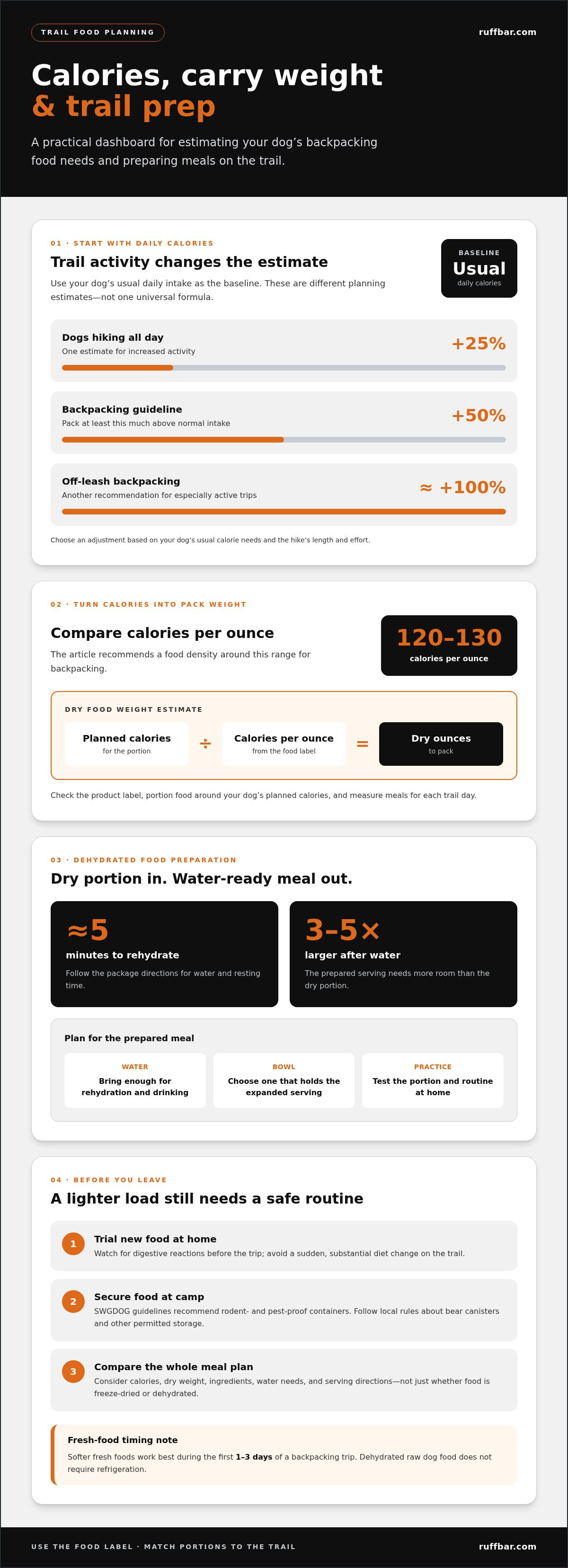
Calorie guidance varies with activity. One estimate suggests dogs hiking all day need about 25% more calories than usual. For an off-leash backpacking trip, another recommendation is to increase daily calories closer to 100%. A separate backpacking guideline advises packing your dog’s usual food and increasing intake by at least 50%. Treat these as different planning estimates, not one universal formula. Your dog’s usual intake and trail effort help determine the adjustment.
Human hiking figures show why trail demands matter, but they aren’t dog-feeding targets. Backpackers typically burn 3,000 to 4,000 calories per day. Thru-hikers covering 20 to 30 miles per day may burn 5,000 to 6,000 calories daily. Don’t apply those human totals to your dog. Instead, use its normal daily calories as your starting point, then account for the hike’s length and intensity.
For a lighter pack, compare calories per ounce on each food label. A recommended backpacking-food density is around 120 to 130 calories per ounce. Divide the calories you plan to feed by the product’s calories per ounce to estimate the dry food weight. Freeze-dried food can be convenient to carry, while dehydrated food may expand substantially after water is added.
Dehydrated food can take around 5 minutes to rehydrate and grow 3 to 5 times its size. That means you’ll need water and a bowl with enough room for the prepared portion. Try the food and preparation routine before departure. One backpacker recommends testing new dehydrated food at home because a dog may have diarrhea or another reaction.
Storage matters at camp. Some areas require bear canisters, so follow local rules on whether you need one or can use another permitted method. Keep dog food secured: SWGDOG guidelines recommend rodent- and pest-proof containers to reduce wildlife access.
High-fat foods are calorie-dense, so a major dietary change can disrupt your dog’s familiar routine. Introduce new food before the hike and watch for digestive reactions. Avoid a sudden, substantial change on the trail, where familiar food and water may be limited.
2. Differences between freeze-dried and dehydrated dog food
Both methods remove moisture, but the processes differ. Freeze-drying freezes food, then removes ice as vapor. Dehydration uses heat and moving air to draw out moisture. For trail planning, compare the finished food’s weight, calories, ingredients, and preparation needs. The label matters more than the method name alone.
Dehydrated food needs water before serving. Add water according to the package directions, stir thoroughly, and let it stand. Rehydration can take around 5 minutes, and the food can expand 3 to 5 times its dry size. Choose a bowl that can hold the prepared serving, not just the dry portion.
This expansion affects camp setup. At home, measure a dry portion, rehydrate it in your usual bowl, and note how much space it takes. Pack a bowl that can hold the prepared meal. Bring water for rehydration as well as drinking, and keep the meal contained while it absorbs moisture.
Freeze-dried food also needs water for serving, but preparation varies by product. Follow the package directions rather than assuming every meal needs the same amount of water or resting time. Pack measured portions in sealed food bags, and bring a separate container for adding water at camp.
Can dogs eat human backpacking meals or dehydrated food? Some plain ingredients may suit a dog, but human meals aren’t automatically appropriate dog food. Check ingredients and feeding directions, and choose dog-formulated food for your dog’s regular trail meals.
Fresh food is another option, but its handling differs from dry meals. Softer fresh foods work best during the first 1 to 3 days of a backpacking trip. Dehydrated raw dog food doesn’t require refrigeration, which can simplify packing after those early days. Plan the sequence around your route and food-storage setup.
For a dog-specific freeze-dried option, compare the ingredient list and serving directions with your dog’s usual food. A trail meal should fit the dog’s feeding routine and your available water. You can explore freeze-dried dog meals as one option for planning lightweight provisions.
Before departure, test the full routine at home: portion the meal, add water, wait as directed, and serve it in the travel bowl. Note how your dog responds and how much water preparation takes. This practice helps you pack suitable portions and avoid discovering a preparation mismatch at camp.
For a recipe-based trail snack, the Hike and Hound Trail Bars recipe uses 1 cup dried apricots, a specific ingredient amount to account for when planning food.
3. Food costs and freeze-dried meal prices
A package price alone won’t tell you what your dog’s trail meals cost. Compare price with calories, serving size, and the number of meals your dog needs. A pouch that looks inexpensive may take several servings to cover one dog-day, while a calorie-dense option may provide more usable fuel per ounce. To find dog backpacking food lightweight enough for a long route, compare the cost per planned serving, not just the package price.
Start with the feeding directions and calorie information on each label. Estimate how much food your dog needs per day, then divide the package into those portions. If the label lists calories per ounce, use that figure to estimate the dry ounces needed for your planned daily calories. Multiply the daily portion cost by the number of trail days, including any food reserved for the return hike.
Compare dog-formulated freeze-dried and dehydrated foods on equal terms. Check calories per serving, ingredients, and whether the food is intended as a complete meal or a topper. A topper may add variety or calories, but it shouldn’t automatically replace a complete daily ration. Use the feeding directions to see how each product fits your dog’s plan.
Human freeze-dried backpacking meals are designed for hikers, not dogs. Their package price doesn’t show what it would cost to feed a dog appropriately. They may also contain ingredients or seasonings unsuitable for dogs. Compare dog foods with dog foods, and assess the cost of human meals separately from your dog’s food budget.
Water changes the practical value of a dry meal, even when it doesn’t change the package price. Dehydrated food can take around 5 minutes to rehydrate and expand 3 to 5 times its dry size. Include preparation water and bowl space in your comparison. For dog backpacking food lightweight enough to carry comfortably, consider the full routine, not just the dry package.
Build a simple trip budget before packing. Record the product, dry portion per day, servings per package, and total packages needed. Include the cost of any familiar food you’ll use during a gradual transition. This makes options easier to compare without mistaking a larger bag for better value. The best fit balances cost, calories, pack weight, preparation, and your dog’s established feeding routine.
That price is a useful reminder that a package’s stated servings don’t necessarily equal a dog’s daily ration. Treat it as a human-meal price point, not a direct estimate of dog trail-food costs. Check the calories and serving guidance, and whether the product is complete dog food or just a topper. Then compare what your dog needs for the planned trip with the price of dog-formulated options. Keeping those comparisons separate helps prevent a low-looking package price from disguising a mismatch in portion or purpose.
4. Planning a dog's backpacking food needs
Build the food plan from your dog’s normal daily ration, then adjust for trail effort. One backpacking recommendation is to pack the usual food and increase daily calories by at least 50%. Another estimate suggests dogs hiking all day may need about 25% more. These are different planning estimates, not amounts to add together. Use the hike’s duration and intensity to guide your target.
Calorie density helps turn that target into pack weight. A suggested density for backpacking food is around 120 to 130 calories per ounce. Check the calories listed on the package, calculate the dry food needed for each day, and portion it before leaving. This makes daily servings easier to track and helps avoid carrying an unmeasured bulk bag.
Pack the right total for the route, not a generic serving chart. One backpacker reported feeding an 80-pound dog a minimum of 3 cups, or 11 ounces, daily on a one-week trip. Another hiker’s dogs ate 4 cups per day each; the hiker estimated 14 liters of kibble for two dogs for a week. These examples show how portions and food volume vary by dog.
Use the food label to check nutrition as well as weight. One recommendation is to choose food with animal protein as its first ingredient and get at least 18% of daily calories from protein sources. Compare calorie information, ingredients, and feeding directions together. A compact portion is useful only if it fits the dog’s dietary needs and normal routine.
Some backpackers discuss adding puppy food to adult kibble for extra calories. Suggestions include mixing in 20% puppy food or replacing about 25% of adult food during hiking trips. These are distinct approaches, not a combined formula. Puppy food changes the meal’s nutrient profile, so don’t treat either percentage as a universal ration.
Fat is energy-dense, but changing the balance of a dog’s diet calls for care. One suggestion is to replace one quarter to one half of a dog’s food with an equivalent number of calories from fat. The same estimate puts fat at about 3,600 calories per pound, compared with about 1,400 to 1,600 calories per pound for cereals and proteins. Keep the dog’s established diet in view while planning.
Finally, secure the ration at camp. SWGDOG guidelines recommend storing dog food in rodent- and pest-proof containers. Portioning meals into sealed daily bags can also help keep the main food supply closed while you serve each meal.
5. Lightweight dog food for camping and backpacking
A lighter food load comes from comparing usable calories with dry weight and planning preparation around water. Don’t judge a ration by package size alone. Check serving weight and calorie information, then portion each meal before packing. Measured daily bags help track supplies and keep the larger food stash closed at camp.
One cup of food discussed in a reader comment weighs 4.1 ounces before water is added and contains 485 Kcal. That’s a specific example, not a universal value for kibble or trail food. Use your own food’s label to compare weight and calories. Your dog’s planned daily ration determines how much you carry.
Dry food can reduce the weight and bulk of meals compared with fresh food, but preparation changes the total load. Dehydrated food absorbs water and can expand 3 to 5 times its dry size. Plan for enough water, a suitable bowl, and room for the meal to rehydrate. Dog backpacking food, lightweight enough to carry, still needs a practical serving setup.
Dehydrated raw dog food doesn’t require refrigeration, which can simplify planning on routes without cold storage. Softer fresh foods work best during the first 1 to 3 days of a backpacking trip. Plan those meals early, then pack dry food for the remaining days. Keep each portion sealed and protected between feedings.
Test your packing setup before departure. Bring together a day’s food, bowl, and preparation supplies, then see how they fit with your gear. Rehydrate a meal at home using the package directions. This shows whether your bowl holds the prepared serving and whether your planned water supply covers preparation as well as drinking.
At camp, open only the portion you’re serving and reseal the rest. SWGDOG guidelines recommend rodent- and pest-proof food containers, so include secure storage in your packing plan. Where bear-canister rules apply, follow local requirements for storing dog food. Dog backpacking food that’s lightweight for the trail must also stay protected and accessible.
For a ready-to-pack option, explore freeze-dried dog backpacking meals and compare their feeding directions with your trail plan.
Ruff Bar: Ruff Stix® Bison Pork
Ruff Stix® Bison Pork is one option for fueling active days outdoors. For a meal made specifically for backpacking, Ruff Bar also offers Ruff Food Freeze Dried Raw Backpacking Meals Beef and Ruff Food Freeze Dried Raw Backpacking Meals Duck. Compare each option with your dog’s usual feeding routine and planned trail portions. Introduce new food before departure, rather than making the first serving a trail test.
Choose according to your dog’s needs and packing plan. Ruff Stix® Beef and Ruff Stix® Pork are additional options. Explore Ruff Bar’s trail-food offerings online.
Build Your Next Trail Plan
Your next step is to turn your dog’s feeding routine into a practical trail plan. Choose a food format, map out daily portions, and make sure your dog has tried the food before the trip. A lightweight dog backpacking food setup should fit both your route and your dog’s established routine.
Ruff Bar offers Ruff Stix® Bison Pork, Ruff Stix® Beef, and Ruff Food Freeze Dried Raw Backpacking Meals Beef. Compare these options with your dog’s needs and your outdoor feeding plan. The right choice is one that fits your packing approach and your dog’s routine.
Ready to plan your dog’s trail food? Contact Ruff Bar about trail food and take the next step toward your next outing. Pack with purpose, then hit the trail together.
Frequently Asked Questions
How Much Food Do You Need?
Pack enough food to cover your dog’s planned daily intake for the full trip, adjusting for trail activity. Portion each day separately and check the total against your route and return plan. Keep familiar food in the mix, especially when introducing something new. Package calorie information helps you compare portions without relying on cup measurements alone.
What is the Difference between Freeze-Dried and Dehydrated Dog Food?
Freeze-dried food has moisture removed from frozen ingredients, while dehydrated food loses moisture through warm air. Both reduce the water weight in the food, but preparation and texture vary by product. Follow the package directions and compare calories per ounce, ingredients, and serving instructions. For dehydrated food, leave room in the bowl for the prepared portion to expand.
How much food does a dog need per day while backpacking?
A dog’s daily amount depends on its normal calorie needs and the effort of the route. One estimate suggests dogs hiking all day need about 25% more calories than usual; backpacking guidance also recommends increasing intake by at least 50%. These are different estimates, not amounts to combine. Use your dog’s usual ration as the baseline, then adjust according to the planned activity.
What is the lightest high-calorie dog food for backpacking?
Compare foods by calories per ounce rather than choosing by format alone. A suggested backpacking-food density is around 120 to 130 calories per ounce, which helps compare how much dry food supplies a planned calorie amount. Check the full feeding directions, too. Rehydration water, meal volume, and whether the food suits your dog all affect how practical a high-density option is on trail.
How much does lightweight backpacking dog food cost per day?
Calculate daily food costs using the package price and the number of servings it provides. Divide the price by the servings, then multiply by the portions your dog needs each day. If the stated servings don’t match your dog’s ration, use the package’s calorie information to estimate the daily share. This lets you compare options without treating package size as a daily serving.