
Compare Dog Food Options and Meal Costs for Backpacking
Do you need to pack dog food in a bear-safe container? It depends on the rules and wildlife risks along your route, so plan storage for your specific trip rather than assuming one setup works everywhere. Choosing dog food for multi-day backpacking trips also means balancing food weight, meal preparation, water needs, and the energy your dog uses on the trail.
It’s easy to focus only on the food. A lightweight option may need added water or preparation, while a calorie-dense meal may reduce the amount you need to carry. Choose food your dog eats reliably and that you can prepare and store safely throughout the hike.
This guide compares kibble, dehydrated food, freeze-dried meals, and other trail-friendly options. You’ll learn how to plan portions, preparation, and drinking water, compare costs by calories rather than package size, and account for your dog’s activity. The goal is practical planning and a food choice that fits the miles ahead.
Key Takeaways
- Compare trail foods by pack weight, preparation needs, and the water required to serve them, not just by the package.
- Plan portions around your dog’s usual diet and trail routine, then test any food change before the trip.
- Estimate meal costs by calories supplied so you can compare options on a more useful basis than package price alone.
- Use your dog’s size, activity, and recovery needs to guide food planning, and account for safe storage along your route.
Accounting for meal-preparation and drinking water
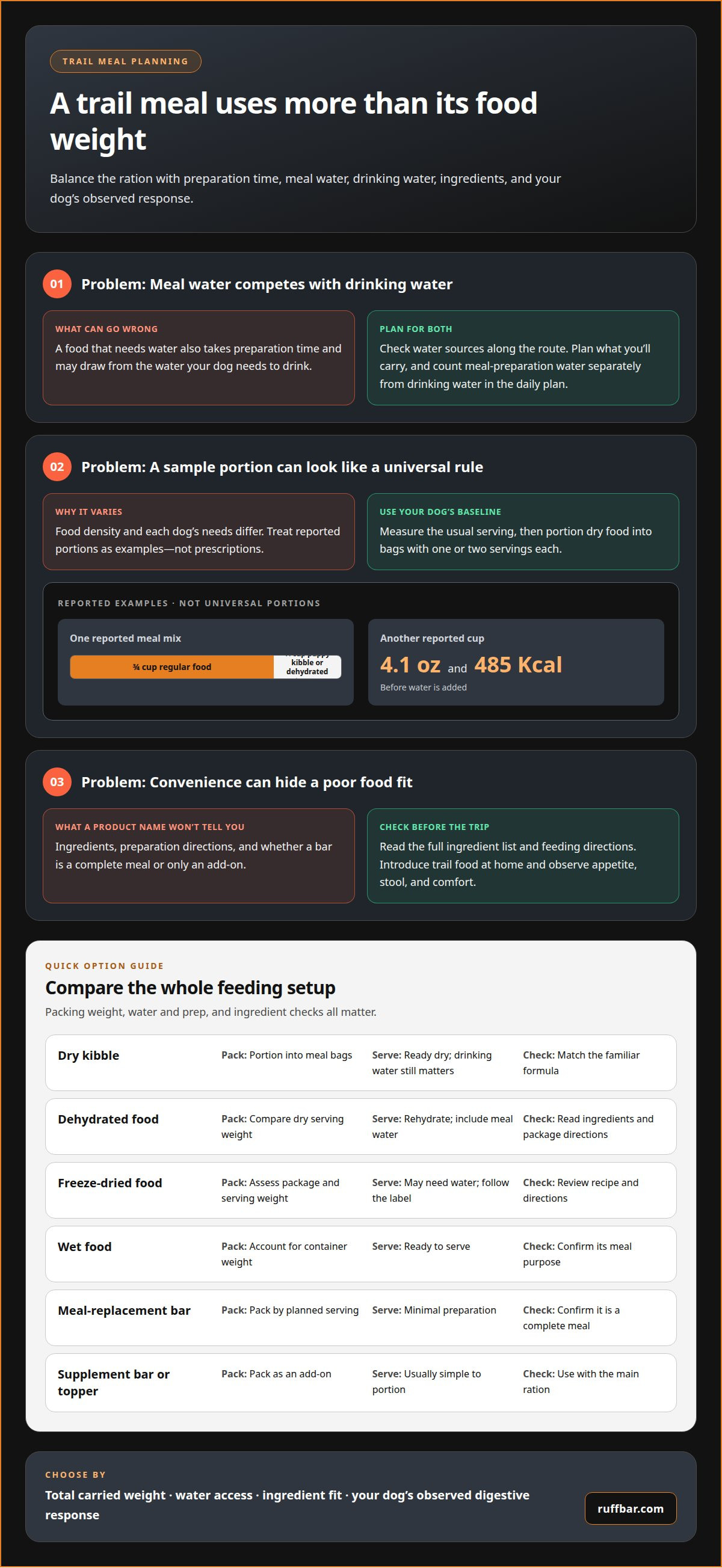
Food weight is only one part of trail packing. A meal that needs water takes preparation time and may draw from the water your dog needs to drink. Check water sources along your route, plan what you’ll carry, and include meal-preparation water separately from drinking water in your daily plan.
Use the current ration as your baseline. One reported approach for a meal usually made with one cup of dog food is three-quarters cup of regular food plus one-quarter cup of puppy kibble or dehydrated meat meal topper. Another reported cup weighed 4.1 ounces and supplied 485 Kcal before water. Treat these as examples, not universal portions: food density and your dog’s needs differ. Measure your dog’s usual servings, then portion dry food into bags with one or two servings each.
Ingredients matter as much as convenience. Read the full ingredient list and feeding directions; a product name alone doesn’t tell you what’s in the food. Introduce trail food at home and observe your dog’s appetite, stool, and comfort. Keeping familiar food on the trail can help avoid an abrupt dietary change. A meal-replacement food and a supplement or snack bar aren’t interchangeable, so check whether the product is intended as a complete meal or an addition.
| Option | Weight and packing | Water and prep | Ingredient check |
|---|---|---|---|
| Dry kibble | Portion into meal bags | Ready to serve; drinking water still matters | Match familiar formula |
| Dehydrated food | Compare dry serving weight | Needs rehydration | Read listed ingredients |
| Freeze-dried food | Assess package and serving weight | May need water; follow label | Review recipe and directions |
| Wet food | Account for container weight | Ready to serve | Check meal purpose |
| Meal-replacement bar | Pack by planned serving | Minimal preparation | Confirm it is a complete meal |
| Supplement bar or topper | Pack as an add-on | Usually simple to portion | Use with the main ration |
Choose based on total carried weight, water access, ingredient fit, and your dog’s observed digestive response, not convenience alone.
What is the Difference between Freeze-Dried and Dehydrated Dog Food?
Kibble is ready to serve dry, while freeze-dried and dehydrated foods are shelf-stable formats that may need water. For backpacking, compare preparation needs, dry food weight, and the water required for each meal.
Freeze-Dried Dog Food
Freeze-dried food is made by removing moisture from frozen ingredients, resulting in a lightweight dry meal. Depending on the product, it may be served dry or rehydrated, so follow its package directions. Compared with kibble, it may take more preparation; its production process also differs from dehydrated food. Check the ingredient panel and serving directions to see what a specific meal contains and how to prepare it.
Dehydrated Dog Food
Dehydrated food is dried to remove moisture and doesn’t require refrigeration. For trail use, measure the dry portion, add the amount of water listed on the package, and allow the stated preparation time. Follow the label to determine the finished yield; dried foods don’t all expand to the same volume. Compared with kibble, this format requires more preparation and water.
Kibble skips rehydration, which can simplify feeding when water is limited. Include its dry serving weight in your packing plan. Freeze-dried and dehydrated meals also start dry; adding water changes the served volume, not the food weight you carried. Plan for drinking water too, especially if meal preparation uses the same supply.
| Food type | Preparation | Water planning | Backpacking trade-off |
|---|---|---|---|
| Kibble | Serve dry | For drinking | Simple feeding, dry ration weight |
| Freeze-dried | Follow package directions | Depends on serving directions | Dry format, possible rehydration |
| Dehydrated | Add package-specified water | Include meal water | Requires preparation time |
Before departure, prepare a serving of each food you’re considering, following its package directions. Compare the finished portion and preparation effort, and observe your dog’s response. Then choose the format that suits your route, water supply, and packing priorities.
Calorie intake, exertion, and veterinary advice
A trail ration needs to suit your dog’s workload, not just its usual bowl. Distance, elevation, pace, terrain, weather, body size, and condition all affect energy needs. Start with what your dog eats at home, then compare that baseline with the planned effort. A steep day carrying a pack is different from a short, level walk. Monitor appetite, energy, and body condition during the trip; use veterinary advice to adjust the feeding plan rather than estimating from distance alone.
Food labels help compare energy density, but calories aren’t the only measure. The National Research Council recommends that dogs get at least 18% of daily calories from protein sources. Review the complete diet, not one ingredient in isolation. A favorite food may be familiar and easy to feed, yet its calorie content and nutrient balance still matter. Don’t add oils or change the ration casually to raise calories. One backpacker reported giving a Heeler 3 cups of food daily, plus 1/2 ounce of olive oil each evening. That account describes one dog, not a general feeding formula.
Real trail examples show why body size alone can’t set portions. A backpacker reported feeding an 80-pound dog 3 cups, or 11 ounces, daily. Another described a 9-pound dog hiking for a long time with plenty of daily exercise. These reports aren’t interchangeable prescriptions. Use them to see how workload, conditioning, and the individual dog shape feeding needs.
Test the planned food before departure. Trying it ahead of time can help you notice whether it causes diarrhea or another reaction. Keep the recipe and serving routine consistent during the test, and note stool quality and appetite. A dog that refuses unfamiliar food at home may also refuse it after a demanding day on the trail.
Plan meal timing around exertion, too. For example, a hiker might reach camp after seven miles before feeding the dog. Use the timing of your own route to plan meals, while following your dog’s comfort and established routine. Base the final schedule on your dog’s usual intake, the trip’s workload, and veterinary advice.
Cost of backpacking meals for dogs
Compare food by calories, not package price alone. A large package may seem economical but contain fewer calories per ounce, while a compact meal may cost more per package. For a fair comparison, use the price and calorie information on each package. Keep added water out of the calculation: it changes prepared volume, not the calories in the dry food.
For example, a hypothetical 4-kilogram bag costs $80 and provides 4,000 kcal per kilogram. Multiply those figures to find 16,000 calories in the bag. Divide the $80 price by 16,000, then multiply by 1,000. The result is $5 per 1,000 calories. This gives a consistent basis for comparing kibble, freeze-dried meals, and other foods, even when their package sizes differ.
Estimate your dog’s calorie needs for the planned hike, using normal food intake and activity as starting points. Divide the daily requirement by the calories per serving listed for each food. Multiply the servings by the cost per serving to estimate food spending for the trip. Keep serving sizes and calorie units consistent. For example, portions measured in cups won’t compare directly with portions measured by weight unless you use each product’s label information.
- Package price: what you pay for the whole bag.
- Calories per package: serving calories multiplied by servings.
- Cost per 1,000 calories: package price divided by calories, then multiplied by 1,000.
- Trail practicality: account for packing weight, preparation, and water needs.
Adding a topper or supplement can change the total meal cost, so include its price and calories in the same calculation. Don’t count an addition as a full meal unless its label identifies it as one. Compare your complete daily ration, not isolated ingredients. For a closer look at trail-ready meal choices, explore backpacking meal options and compare their package details with your trip plan.
Ruff Bar
Ruff Bar offers trail-focused options for active dogs, including Ruff Food Freeze Dried Raw Backpacking Meals in Beef and Duck, as well as Ruff Stix® Bison Pork. Compare these formats with your dog’s calorie needs, familiar feeding routine, and meal-preparation plan.
Ruff Bar’s nutrition products use USDA-graded grass-fed meats and whole organic ingredients, with no fillers. Compare each product’s ingredient information and package directions with your route’s water needs, food-weight limits, and preparation requirements. Introduce any new food before a demanding trip so you can observe your dog’s response during ordinary feeding.
If you’re weighing trail meal options for your dog, contact Ruff Bar to discuss the available products.
Make Your Next Trail Meal Decision
Use your next outing to see how well your plan works. Choosing dog food for multi-day backpacking trips means matching your dog’s established routine to the route’s demands, then paying attention to what happens on the trail. Use those observations to refine your packing and meal choices for future trips.
Ruff Bar offers Ruff Stix® Bison Pork, Ruff Food Freeze Dried Raw Backpacking Meals Beef, and Ruff Stix® Beef. Compare these options with other food formats as you plan for your dog’s next adventure. Keep the decision grounded in your dog’s needs and the realities of your route.
For help exploring backpacking meal options, contact Ruff Bar about backpacking meals. Then get outside with a plan that helps both you and your dog move forward with confidence.
Frequently Asked Questions
Do you have to pack dog food in a bear-safe container?
Not always; bear-safe storage may involve a designated container or another approved method, such as hanging food. Follow the storage directions for your campsite and route, and store your dog’s food with other scented items. If hanging food, keep it at least 10 feet off the ground and 4 feet from branches and tree trunks. Pack waste out as well.
Does Dehydrated Food Save Pack Weight?
Dehydrated food may weigh less than a moist meal before preparation because moisture has been removed. Compare the dry serving weight shown on each package, not the prepared bowl’s volume, and account for the water needed to rehydrate it. If you must carry that water, include it in the total load. If you can safely source water along your route, preparation may add less carried weight.
How much dog food should you pack for a backpacking trip with dogs?
Pack your dog’s measured daily ration for each planned day, plus food for an extra day in case the trip runs long. Stick with food your dog already eats unless you’ve introduced a change in advance. Portioning by day helps prevent using too much food early and makes it easier to notice a missing meal before you leave camp.
What dog food is best for multi-day backpacking trips?
The best dog food for multi-day backpacking trips is food your dog eats reliably and that fits your route’s water, weight, and preparation demands. Compare complete meals rather than treating a topper or snack as a full ration. Kibble may suit a no-prep routine, while a shelf-stable meal may fit a different packing plan. Follow the product’s feeding directions.
How many calories does a dog need per day while backpacking?
There’s no single daily calorie target for every trail dog. Start with the calories your dog normally eats, then account for changes in effort, terrain, pace, and body condition. Use the food label’s calories per serving to track intake. A veterinarian can help set a suitable target, especially when your dog’s workload changes sharply from its usual routine.
How much dog food should I pack per day based on my dog's weight and activity?
Body weight alone doesn’t determine a reliable food amount. Start with your dog’s usual daily serving, then use the product’s label and portion size to calculate the food weight. Account for the planned workload and monitor appetite, energy, and body condition on the trail. If activity increases substantially, ask your veterinarian how to adjust the daily ration safely.