
What Does Grain-Free Actually Mean for Dogs? Ingredients, Nutrition, and Health
What if “grain-free” tells you less about your dog’s nutrition than the label suggests? If you’ve wondered what does grain-free actually mean for dogs, the short answer is that it describes ingredients left out, not a complete nutrition plan. It’s easy to read the label as a sign of better health, especially when grain-free, gluten-free, and low-carbohydrate can sound like similar promises. They aren’t.
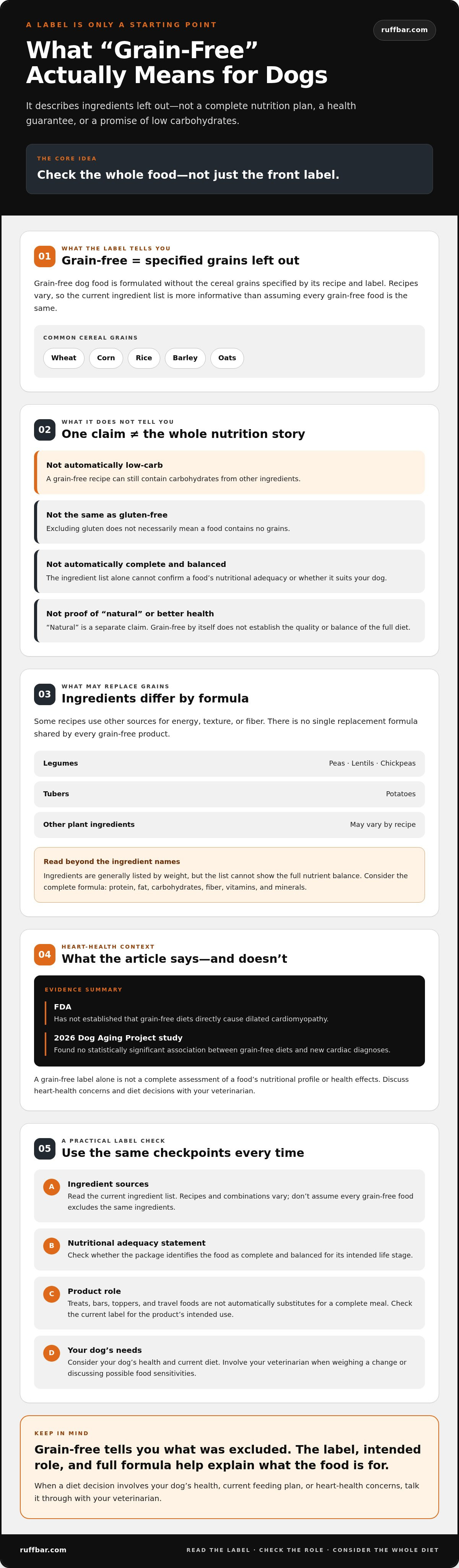
Grain-free foods exclude cereal grains such as wheat, corn, rice, and barley. They may use potatoes, peas, lentils, or chickpeas instead, so grain-free doesn’t automatically mean low-carb. Nor does it guarantee that a food is complete and balanced or right for your dog. Heart-health headlines can add to the uncertainty: the FDA hasn’t established that grain-free diets directly cause dilated cardiomyopathy, and a 2026 Dog Aging Project study found no statistically significant association between grain-free diets and new cardiac diagnoses.
This guide explains what the label does and doesn’t tell you, which ingredients may replace grains, and how to assess a food’s nutritional adequacy and fit for your dog. You’ll also learn when to involve your veterinarian in the decision.
Key Takeaways
- To answer “what does grain-free actually mean for dogs,” check the ingredient list. Recipes differ, and the label alone won’t reveal the whole formula.
- Compare foods using the same checkpoints: ingredient sources, nutritional adequacy statement, and intended life stage.
- Identify a product’s role before serving it. Treats, bars, toppers, and travel foods aren’t automatically substitutes for a complete meal.
- Discuss your dog’s health, current diet, and any heart-health concerns with your veterinarian when weighing a diet change.
What Does Grain-Free Actually Mean for Dogs?
Grain-free dog food is formulated without specified cereal grains. That’s an ingredient-exclusion claim, not a complete description of what’s in the bowl. If you’re asking what does grain-free actually mean for dogs, start with the product’s current ingredient list. Recipes and label terminology vary, and the front-of-pack claim won’t show every detail of the formula.
Grain-free describes what’s left out, not the food’s overall quality or health benefits. It doesn’t automatically mean gluten-free, carbohydrate-free, or nutritionally complete. A food can exclude grains and still contain carbohydrates from other sources. Check the product’s nutritional adequacy information to see whether it’s intended to provide a complete diet for a particular life stage. For foundational background on canine diets and food types, see Dog food.
Which ingredients count as grains in dog food?
Common cereal grains include wheat, corn, rice, barley, and oats. A grain-free formula is made without the grains specified by its formulation and label, but ingredients and combinations differ from product to product. Read the current ingredient list rather than assuming every grain-free food excludes the same ingredients.
Grain-free also isn’t the same as gluten-free. Gluten is associated with some grains, but excluding gluten doesn’t necessarily mean a food contains no grains. Nor does a grain-free label mean your dog needs grains removed. Don’t assume a dog will react to grains. If you’re concerned about a food sensitivity, discuss the signs and next steps with a veterinarian.
Does grain-free mean low-carb or more natural?
No. A grain-free recipe may use other carbohydrate sources, such as potatoes, peas, or lentils. These are examples, not universal replacements. Removing one group of ingredients changes the recipe, but it doesn’t tell you the total carbohydrate content or whether the overall nutrition suits your dog.
“Natural” is a separate claim to assess. The ingredient list can show what a product contains, but it can’t establish the quality or balance of the full diet on its own. Check the product’s intended role and nutritional adequacy information, too. A snack, topper, or travel food shouldn’t be treated as a complete meal unless its current labeling confirms that use.
How Grain-Free Dog Food Is Formulated and What Replaces Grains
Removing grains changes a recipe, but it doesn’t determine whether that recipe provides complete nutrition. To understand what does grain-free actually mean for dogs beyond the label, consider the full formula: protein, fat, carbohydrates, fiber, vitamins, and minerals all contribute to a food’s nutritional profile. The proportions and sources matter, too.
Grain-free is an ingredient description, not a nutrient profile. A recipe might use different ingredients to provide energy, texture, or fiber, but there’s no single replacement formula shared by every grain-free product. Ingredients aren’t automatically good or bad because they replace grains. Their role in the overall recipe matters.
What ingredients can replace grains?
Depending on the formula, manufacturers may use legumes such as peas or lentils, tubers such as potatoes, or other plant ingredients. Check the ingredient list to see what’s included and where each item appears. Ingredients are generally listed by weight, but the list alone can’t tell you the recipe’s full nutrient balance. Pair it with the package’s nutrition information, and contact the manufacturer if you need details about the formula.
Ingredient choices can also raise questions about how a food was designed. The FDA investigation into canine heart health offers context on reports involving certain diets. A grain-free label, by itself, doesn’t provide a complete assessment of a food’s nutritional profile or health effects.
How to check whether a food is nutritionally complete
Find the nutritional adequacy statement on the package. Check whether the food is identified as complete and balanced for your dog’s intended life stage, rather than relying on front-label phrases or the ingredient list alone. The statement clarifies the product’s intended nutritional role, but it doesn’t mean every food is the right fit for every dog.
Then check what you’re actually feeding. Treats, energy bars, toppers, and travel foods aren’t automatically complete meals. Ruff Bar offers grain-free options in categories such as food bars, Stix, freeze-dried backpacking meals, and toppers. Review each product’s current label to understand how it fits into your dog’s feeding plan. You can also explore grain-free adventure nutrition and check the product information for the item you’re considering.
If the adequacy statement, life-stage wording, or product role isn’t clear, ask the manufacturer for clarification. Your veterinarian can help assess whether a food suits your dog’s individual needs, especially before a significant diet change.
Grain-Free vs. Grain-Inclusive Dog Food: How to Compare Them
A useful comparison starts with the whole recipe, not one ingredient or front-label claim. Grain-free and grain-inclusive foods can both be formulated for a dog’s nutritional needs. Neither category is automatically superior. To understand what does grain-free actually mean for dogs in practice, compare the same details on both packages, then consider your dog’s health and tolerance.
| What to compare | Grain-free food | Grain-inclusive food |
|---|---|---|
| Grain presence | Formulated without specified cereal grains. Check the current ingredient list. | Includes one or more cereal grains. Check which grains appear in the recipe. |
| Other ingredients | May use alternatives such as potatoes, peas, or lentils. The formula varies. | May include other carbohydrate sources alongside grains. The formula varies. |
| Nutritional adequacy | Read the adequacy statement. The grain-free claim alone doesn’t establish completeness. | Read the adequacy statement. The presence of grains alone doesn’t establish completeness. |
| Intended life stage | Check which life stage the food is formulated for. | Check which life stage the food is formulated for. |
What should you compare on the label?
Compare named ingredients, the nutritional adequacy statement, and intended life stage. Then review feeding directions and calorie information where available. Together, these details help you judge the full recipe and how it fits your dog’s needs. Don’t decide based on one ingredient in isolation. Identify the product’s role, too: snacks and toppers aren’t automatically complete meals. For more on the difference, see this guide to high-protein dog energy bars.
When might grain-free be relevant to an individual dog?
A diagnosed dietary need is different from choosing grain-free by preference. If a food reaction is suspected, a veterinarian may guide an elimination diet to help identify a trigger. Don’t diagnose an allergy or remove ingredients on your own. Get professional guidance first. The FDA has investigated reports involving certain diets and canine dilated cardiomyopathy, but reports and associations don’t prove that grain-free food causes heart disease. Read the FDA investigation into diet and canine heart disease for context. The right choice depends on the dog, the full formula, and veterinary advice when health concerns arise.
Grain-Free Diets and Canine Heart Health: What Owners Should Know
Heart-health headlines can make a food choice feel urgent. The evidence calls for attention, not assumptions. The U.S. Food and Drug Administration (FDA) investigated reports of canine dilated cardiomyopathy (DCM) in dogs eating certain diets, including some labeled grain-free. DCM is a disease of the heart muscle that can reduce its ability to pump blood effectively.
An investigation can identify a concern worth studying, but it does not prove that a particular ingredient or diet caused the disease. The FDA has not established a direct causal relationship between grain-free diets and DCM. In its December 2022 update, the agency said it would provide no further public updates until meaningful new scientific information became available. Read the FDA’s investigation details for its current public guidance.
What is known about diet-associated dilated cardiomyopathy?
Research continues to examine the issue. A 2026 Dog Aging Project study found no statistically significant association between eating a grain-free diet and a higher risk of a new cardiac diagnosis. A June 2026 research update reviewing more than 30 studies since 2018 identified diets high in pulse ingredients, such as peas and lentils, as a possible common factor in diet-associated cases, whether the diets were grain-free or grain-inclusive. The exact mechanism remains unclear. These findings don’t settle every question, but they reinforce why “grain-free” alone isn’t a complete explanation of risk.
So, what does grain-free actually mean for dogs in this context? It describes an ingredient exclusion. On its own, it can’t establish whether a food is safe or unsuitable for an individual dog. Don’t treat the label as proof of harm or as proof that a diet is risk-free.
When should you discuss your dog’s food with a veterinarian?
Talk with your veterinarian before changing a complete diet because of a health concern. Bring the food packaging or a clear photo of its label, along with a record of treats, toppers, and supplements. That full picture can help the veterinarian assess the overall feeding routine and discuss appropriate next steps.
Seek prompt veterinary care if your dog has concerning signs such as difficulty breathing, fainting, unusual weakness, or a marked drop in exercise tolerance. These symptoms can have different causes, so don’t try to diagnose them or manage them by changing food alone.
If you’re comparing grain-free snacks or adventure foods, review Ruff Bar’s product details and current labels to understand each item’s intended role. Explore Ruff Bar’s grain-free dog nutrition as one example, not as a recommendation that every dog needs a grain-free diet.
How to Choose Grain-Free Products for Your Dog With Confidence
Make the decision in order: identify the product’s role, read its current label, assess whether it suits your dog, and ask questions if anything is unclear. This keeps the grain-free claim in perspective and helps you choose based on the whole product, not a single phrase on the package.
A quick checklist for reading grain-free labels
- Identify the role. Is it labeled as a complete food, or as a treat, topper, energy bar, or travel food? Don’t assume a complementary product can replace a meal.
- Check the current package. Review the ingredients, feeding directions, calorie information if provided, and intended life stage.
- Assess your dog’s needs. Consider their age, health, usual diet, and any veterinarian-guided dietary plan. Grain-free isn’t automatically a better match.
- Ask for clarity. Contact the manufacturer about product-label details, and ask your veterinarian whether the product suits your dog.
Keep the package or take a clear photo of the label. That makes questions easier to answer, especially when you’re comparing options or discussing a diet change with your veterinarian.
Where grain-free snacks and adventure foods fit
Treats and toppers belong within your dog’s overall feeding plan. Consider how they fit alongside the regular diet, and follow package directions rather than treating them as a meal by default. For trip-planning context, see this freeze-dried raw dog food backpacking guide. Check each product’s current label for its intended use and feeding directions.
Ruff Bar offers grain-free products for active dogs, including food bars, Stix, freeze-dried backpacking meals, toppers, and supplements. These categories can serve different roles, and the grain-free description doesn’t establish that every item is a complete diet or suitable for every dog. Check the specific product information before deciding how it fits your routine.
The practical takeaway is simple: match the product to the job, confirm what the label says, and get professional guidance when your dog’s health is part of the decision. If a Ruff Bar option fits your dog’s needs and feeding plan, explore the range at your own pace.
Choose the Food That Fits Your Dog’s Trail
The clearest answer to what does grain-free actually mean for dogs is simple: certain grains are excluded, but the label alone doesn’t tell you whether a product is complete, balanced, or right for your dog. Read the current ingredient list and nutritional adequacy statement. Check the intended life stage and the product’s role, too.
Grain-free and grain-inclusive foods can both fit a dog’s diet. What matters is the full formula and your dog’s individual needs. Heart-health concerns deserve a measured conversation with your veterinarian, not a rushed decision based on a label. Before changing a complete diet, bring the food label and a record of treats and supplements to that discussion.
For active dogs, Ruff Bar offers grain-free snacks and freeze-dried meals. Its formulas use USDA-graded grass-fed meats and whole organic ingredients without fillers, but check each product’s current label to confirm ingredients and intended use. If you’re looking for options for your next outing, explore Ruff Bar’s grain-free nutrition for active dogs. Choose with the label and your dog’s needs in view, then get out there together.
Frequently Asked Questions
Is grain-free dog food healthier than food with grains?
No food category is automatically healthier for every dog. A grain-free label doesn’t guarantee higher quality or better health, and grain-inclusive recipes can provide useful nutrients, including fiber, vitamins, and minerals. Compare the complete formulas, including their nutritional adequacy statements and intended life stages. Your dog’s health, tolerance, and any diagnosed dietary needs matter more than the grain-free claim alone. Ask your veterinarian for guidance if you’re considering a change for health reasons.
Can grain-free dog food cause heart problems in dogs?
The FDA has not established that grain-free diets directly cause dilated cardiomyopathy (DCM), a disease of the heart muscle. Its investigation examined reports involving certain diets, but reports and associations don’t prove causation. A 2026 Dog Aging Project study found no statistically significant association between grain-free diets and new cardiac diagnoses. Research continues, and diet-associated DCM remains a complex issue. Discuss your dog’s food with a veterinarian if heart health is a concern.
Does grain-free mean a dog food has no carbohydrates?
No. Grain-free means the formula excludes specified cereal grains, not all carbohydrate sources. A recipe may contain carbohydrates from ingredients such as potatoes, peas, or lentils. The amount and sources vary by product, so the grain-free claim alone can’t tell you how much carbohydrate the food contains. Check the package’s nutrition information and ingredient list, and ask the manufacturer if you need details that aren’t provided on the label.
What ingredients replace grains in grain-free dog food?
There isn’t one standard substitute. Depending on the formula, ingredients may include potatoes, peas, lentils, chickpeas, or other plant-based sources. These ingredients can serve different roles in a recipe, and their presence doesn’t by itself determine whether a food is suitable or nutritionally complete. Review the full ingredient list and the product’s nutritional adequacy statement. Avoid judging a food’s quality by one ingredient in isolation.
Do dogs need grains in their diet?
Dogs don’t necessarily need cereal grains specifically if they eat a nutritionally complete diet suited to their needs. Grains can contribute nutrients, including fiber, vitamins, and minerals, so their presence isn’t automatically a problem. Don’t remove grains simply because a label suggests grain-free is better. If you suspect your dog has a food reaction, speak with a veterinarian before changing ingredients or beginning an elimination diet.
How can I tell whether a grain-free dog food is complete and balanced?
Look for the nutritional adequacy statement on the package and check the life stage it identifies. Don’t rely on “grain-free” or ingredient claims alone. Also confirm whether the product is intended as a complete food or as a treat, topper, energy bar, or travel food. Those products aren’t automatically substitutes for meals. If the label’s intended use or adequacy information is unclear, ask the manufacturer or your veterinarian.