
Weight Management for Sporting Dogs: Optimizing the Power-to-Weight Ratio
Every extra ounce is an anchor. On a steep ascent in the backcountry, your dog isn't just a companion; they're a high-performance machine where gravity is the ultimate enemy. Achieving peak weight management for sporting dogs isn't about dieting. It's about engineering. It's about maximizing the power-to-weight ratio so every muscle fiber serves a purpose. You've likely felt the frustration of watching your partner flag on day three of a trek. You've worried about the long-term impact of joint strain from carrying unnecessary bulk.
You understand that "performance lean" looks different than the average pet weight. You want endurance. You want power. You want a dog that recovers before the sun hits the horizon. This guide will help you master the science of keeping your canine athlete lean, muscular, and ready for the most demanding expeditions. We'll provide a clear framework for adjusting calories based on real-world output. You'll learn how to use precision tools like Ruff Stix® and Pure Blend Toppers to fuel the engine without adding the fluff. Let's optimize for the trail ahead.
Key Takeaways
- Understand how excess weight multiplies joint impact by four times. Protect your athlete's longevity by optimizing their power-to-weight ratio.
- Master the "Sporting Lean" standard. Use the rib touch test to maintain a precise Body Condition Score between 3.5 and 4.
- Discover the science of weight management for sporting dogs through tactical calorie cycling. Adjust fuel based on the day's mission intensity.
- Ditch the fillers. Prioritize nutrient-dense proteins and fats to eliminate digestive drag and maximize endurance on the trail.
- Use precision tools like Ruff Stix® and Pure Blend Toppers. Fuel muscle growth and recovery without adding unnecessary caloric fluff.
The Power-to-Weight Ratio: Why Ounces Matter
Performance is propulsion. Weight is resistance. In the world of elite canine athletics, the power-to-weight ratio is the only metric that matters. This ratio represents the balance between the force generated by muscle and the total mass the dog must move. For every extra ounce of body fat, your dog pays a tax in speed and stamina. Effective weight management for sporting dogs focuses on stripping away this dead weight to reveal a machine built for the trail. Every ounce is an anchor; every muscle fiber is an engine.
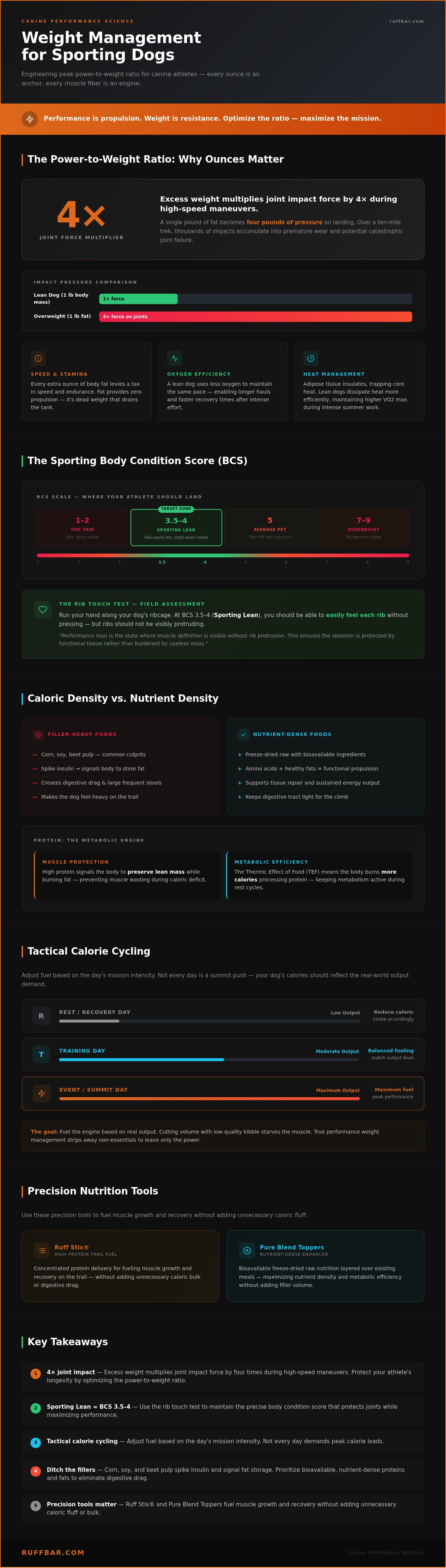
Gravity doesn't play favorites. When a dog jumps, pivots, or sprints, the force on their joints isn't just their body weight. It's multiplied. Research indicates that excess weight can increase joint impact force by four times during high-speed maneuvers. A single pound of fat becomes four pounds of pressure on a landing. Over a ten-mile trek, those thousands of impacts add up to premature wear and catastrophic failure. Keeping your dog lean isn't just about speed. It's about protecting the hardware.
Fat is metabolically expensive. It requires blood flow but provides no propulsion. It is dead weight that drains the tank. A lean dog uses less oxygen to maintain the same pace, allowing for longer hauls and faster recovery times. When you eliminate the caloric fluff, you increase the efficiency of the entire system.
The Joint Impact of Resistance
The carpus and hock are the primary shock absorbers for a working dog. These structures are designed to handle immense loads, but they have a breaking point. Lean mass supports ligament integrity by providing a stable, muscular framework that absorbs energy before it reaches the connective tissue. Performance lean is the state where muscle definition is visible without rib protrusion. This condition ensures the skeleton is protected by functional tissue rather than burdened by useless mass.
Thermoregulation and Aerobic Capacity
Heat is a silent performance killer. Adipose tissue acts as an insulator, trapping core heat and forcing the heart to work harder to cool the body. Lean dogs dissipate heat more efficiently because they lack this insulating layer. This allows them to maintain a higher VO2 max during intense summer work. High aerobic capacity requires a body that can breathe and cool itself without fighting its own insulation. To understand how to fuel this high-output state, explore High Protein Dog Energy Bars: The Science of Sustained Adventure Fuel for insights on precision nutrition.
Caloric Density vs. Nutrient Density
Weight management for sporting dogs is often misunderstood as a simple reduction in volume. If you cut volume while using low-quality kibble, you starve the muscle. Most "lite" dog foods use fiber to bulk out the bowl. This creates digestive drag. It makes the dog feel heavy. It leads to large, frequent stools that interrupt the mission. You need functional fuel. Amino acids and healthy fats provide the propulsion. Carbs and fillers provide the bulk. True performance weight is about stripping away the non-essential to leave only the power.
Adhering to established canine caloric and nutrient density guidelines is critical for high-stakes athletes. These standards highlight the need for concentrated energy sources that don't compromise the dog's metabolic efficiency. An athlete needs more than just a full stomach. They need the specific building blocks that support tissue repair and sustained energy output during weight management for sporting dogs.
The Problem with Fillers
Corn, soy, and beet pulp are common culprits in standard dog food. They're cheap. They're effective at filling space. However, they spike insulin levels. High insulin signals the body to store fat rather than burn it. This is a metabolic trap for a canine athlete. Unlike filler-heavy kibble, nutrient-dense freeze-dried raw options prioritize bioavailable ingredients. They eliminate the metabolic waste that hinders performance and keep the digestive tract light for the climb.
Protein as a Metabolic Engine
Protein is more than a building block. It's a metabolic driver. The thermic effect of food (TEF) means the body burns more calories just to process protein compared to fats or carbohydrates. This helps maintain a lean profile even during rest cycles. High-quality amino acids are also essential to prevent muscle wasting. When an athlete is in a caloric deficit, the body may look to muscle for energy. Sufficient protein intake stops this atrophy.
- Muscle Protection: High protein levels signal the body to preserve lean mass while burning fat.
- Metabolic Efficiency: Protein digestion keeps the metabolism active and burning.
- Superior Sourcing: Grass-fed bison and pork provide cleaner energy than grain-finished alternatives.
These proteins offer superior micronutrient profiles that support recovery and long-term vitality. For those looking to optimize their dog's diet, exploring performance-focused nutrition is the next step toward backcountry excellence. Fuel the machine. Protect the muscle. Win the trail.
Assessing the Sporting Body Condition Score (BCS)
The standard 9-point Body Condition Score (BCS) was built for the average pet. For the backcountry athlete, that scale is too broad. Effective weight management for sporting dogs requires a more precise target: the "Sporting Lean" standard. On a 1-9 scale, your partner should sit between 3.5 and 4. This is the sweet spot. It is the point where muscle mass is maximized and parasitic fat is minimized. At this level, ribs are easily felt and sometimes visible. This isn't malnutrition. It is conditioning.
Muscle tone is a secondary metric that weight alone cannot capture. A dog can be at the right weight but lack the "hardness" required for endurance. When you palpate the shoulders and thighs, the tissue should feel firm and resilient. It should feel like a tensed human bicep. If it feels like soft dough, the power-to-weight ratio is off. You have mass without the corresponding force. Conditioning is the goal; the scale is just a tool.
The Rib Touch Test
The ribcage is the most reliable indicator of fat cover. Run your hands along your dog's side with light pressure. You should feel each rib distinctly without having to dig. To calibrate your touch, use the knuckle test. Make a fist. Feel your knuckles; that is a dog that is too thin. Feel the back of your hand; that is a BCS 4. Feel your palm; that is a dog carrying too much weight. Differentiate between fat and skin. Some breeds have thick, loose skin that can mask the ribs. Focus on the hard structure beneath the surface. If you have to press to find the bone, you are looking at fat cover, not skin.
Evaluating the Waist and Tuck
Visual assessment starts from two angles: the bird's eye view and the profile. From above, look for a clear hourglass silhouette. The waist should narrow significantly behind the ribs before widening at the hips. From the side, look for the abdominal tuck. The belly should rise sharply from the end of the ribcage toward the groin. Breed standards matter here. A sighthound will have a dramatic, deep tuck. A retriever or pointer will have a more moderate rise. Regardless of breed, the tuck must be visible and firm. A flat underline is a sign of excess. A sag is a failure of weight management for sporting dogs. Demand more from the physique. Optimize the silhouette for the mission.
Tactical Calorie Cycling for Training and Events
Static feeding is a relic of domesticity. It fails the athlete. For a sporting dog, every day is not the same. One day involves a ten-mile ridge run; the next is spent recovering in the truck. Effective weight management for sporting dogs requires tactical calorie cycling. This method aligns energy intake with energy expenditure. It prevents the accumulation of unwanted fat on rest days and ensures the tank isn't empty when the grade gets steep. You feed for the mission, not the routine.
Precision starts with understanding the two numbers that drive the engine. The Base Metabolic Rate (BMR) is the energy required to maintain basic biological functions at rest. The Active Energy Requirement (AER) is the total fuel needed to power the day's movement. On a rest day, your protocol should prioritize high protein to maintain muscle mass while dropping fats to their lowest functional level. This keeps the dog lean without sacrificing repair capability. On a summit day, the script flips. You need high-density fats to provide sustained endurance and protect the muscle from being used as fuel.
Calculating the Daily Mission Load
Not every outing is an expedition. Handlers should categorize days into three distinct loads to master weight management for sporting dogs. A low-activity day (1.0x to 1.2x BMR) covers basic maintenance. A moderate day (1.5x to 2.0x BMR) involves several hours of steady work. A high-activity day (3.0x BMR or more) represents grueling backcountry work or multi-day trials. This multiplier framework allows you to adjust the bowl before the work begins. For a deeper dive into optimizing these nutrients, read Performance Dog Food Supplements: Fueling the Modern K9 Athlete.
Mid-Trail Fueling for Steady Glucose
Endurance is a game of glucose management. Large meals during work cause blood to divert to the gut, leading to lethargy and energy crashes. Small, frequent snacks keep glycogen levels steady and the mind sharp. This is where fat-loading becomes a strategic advantage, especially in cold-weather expeditions where the body burns calories just to stay warm. Precision tools like Ruff Stix® are engineered for this exact purpose. They provide a concentrated burst of protein and fat without the bulk of a full meal. They fit in a pocket and deploy in seconds. Use them to cycle calories in real-time as the terrain changes. Shop Ruff Stix® for your next mission.
The Ruff Bar Strategy: Precision Nutrition for Lean Power
Nutrition is equipment. For the serious handler, the bowl is as critical as the harness or the GPS. Weight management for sporting dogs shouldn't rely on garden-variety fillers like green beans or rice. These add bulk to the gut without fueling the muscle. They create digestive drag. The Ruff Bar approach centers on nutrient density. We use the Pure Blend strategy to eliminate metabolic waste. This ensures every calorie consumed is a calorie used for propulsion. No fluff. No fillers. Just power.
Freeze-dried raw meals offer the ultimate solution for precise weight management for sporting dogs in the backcountry. On a multi-day trek, guessing at portions is a liability. Ruff Food Freeze Dried Raw Backpacking Meals allow for exact caloric accounting. You know exactly what goes into the engine. This precision prevents the subtle weight gain that occurs with overfeeding and the energy crashes that follow underfeeding. It's about maintaining that BCS 4 through accurate, high-stakes fueling. Every gram counts when the mission is on the line.
Eliminating the "Pack Weight" of Digestion
A high-residue diet is a burden. When a dog consumes low-quality proteins and high-fiber fillers, the body struggles to process the waste. This results in large, soft stools and a heavy digestive tract. Ruff Bar products utilize USDA-graded meats that promote maximum muscle synthesis. The efficiency of these ingredients leads to smaller, firmer stools. This is low-residue nutrition. It keeps the dog light on their feet and ready for the next ascent. For a deep dive into backcountry feeding, see The Ultimate Guide to Freeze Dried Raw Dog Food for Backpacking (2026). Choose efficiency over volume. Focus on the results.
Strategic Supplementation for Recovery
Recovery is where the next day's performance is built. Ruff Supplements and Ruff Bar Functional Nutrition Toppers provide the targeted nutrients required for tissue repair without the caloric load of a full meal. These tools support ligament integrity and metabolic efficiency. Hydration is the often-overlooked factor in weight management. Our toppers encourage water intake, ensuring the metabolic system can flush byproducts and transport nutrients effectively. Don't settle for domestic standards. Optimize your dog’s performance with Ruff Bar’s precision nutrition. Build the athlete. Own the trail. Fuel the shared adventure with uncompromising quality.
Engineered for the Ascent
Performance isn't an accident. It's the result of disciplined engineering and uncompromising fuel. You now have the framework to master weight management for sporting dogs by prioritizing nutrient density over empty bulk. You understand how to cycle calories for the mission and how to maintain the "Sporting Lean" standard that protects joints and powers endurance. Ounces are obstacles; muscle is momentum. Every extra pound of fat is a tax on your dog's longevity and speed.
Don't compromise on the gear that goes inside the machine. Use USDA-graded grass-fed meats and high-standard nutrition to ensure your partner is ready for the most demanding backcountry hauls. Eliminate the grains. Strip away the fillers. Maximize the recovery. Every trek is a shared test of preparation and grit. It's time to build the athlete your partner was born to be. Focus on the power-to-weight ratio and watch the results on the next climb.
Fuel your dog’s next mission with Ruff Bar. Zero grains, zero fillers, and zero compromise. See you on the trail.
Frequently Asked Questions
How can I tell if my sporting dog is too thin or just lean?
Distinguish between lean muscle and malnutrition by checking muscle hardness and energy levels. A lean athlete maintains a Body Condition Score of 3.5 to 4, where ribs are easily felt but not sharply protruding. Look for visible muscle definition in the shoulders and thighs. If hip bones and the spine are prominently visible with no muscle covering, the dog is likely too thin. Lean dogs remain high-energy; thin dogs flag quickly.
Will a high-protein diet cause my dog to gain weight?
Protein alone does not cause weight gain; excess calories from carbohydrates and fats do. Protein has a high thermic effect, meaning the body burns more energy during digestion. This supports weight management for sporting dogs by preserving lean muscle mass while the body targets fat for fuel. High-protein, grain-free options like Ruff Food provide essential building blocks for muscle without the caloric fluff found in standard filler-heavy kibbles.
How many calories does a working dog need during a full day of hunting?
A working dog in the field often requires three to four times their Base Metabolic Rate. Depending on terrain and intensity, a medium-sized breed can burn between 1,500 and 3,500 calories in a single day. You must adjust intake based on the daily mission load. High-fat, nutrient-dense fuel is critical during these events to prevent glycogen depletion. It sustains power and ensures the dog doesn't finish the day in a massive caloric deficit.
Is it safe to cut calories for an active dog during the off-season?
Reducing caloric intake during periods of lower activity is essential for health. Feeding a high-intensity diet to a sedentary dog leads to rapid fat accumulation and joint strain. Lower the fat content while maintaining high protein levels to prevent muscle atrophy. Tactical calorie cycling ensures your dog stays at a performance weight year-round. This makes the transition back to peak conditioning easier when the next season begins.
What are the best low-calorie treats for training sporting dogs?
Prioritize nutrient density and functional benefits over simple "low calorie" labels. Treats should provide a protein boost without adding unnecessary bulk. Use small pieces of high-protein snacks like Ruff Stix® for precision fueling during repetitive training. Avoid grain-heavy biscuits that spike insulin and promote fat storage. Pure meat treats offer the highest reward value and metabolic efficiency. They keep the dog focused and the waistline tight during the off-season.
How does excess weight affect a dog’s ability to hunt or hike?
Extra weight multiplies joint impact by four times during high-speed maneuvers. It acts as an insulator, causing the dog to overheat faster and struggle with thermoregulation. Carrying dead weight also drains aerobic capacity, leading to premature fatigue and slower recovery times. In weight management for sporting dogs, stripping away fat is the most effective way to improve speed and stamina. It protects the hardware for long-term performance in the backcountry.
Can I use freeze-dried raw food to help my dog lose weight?
Freeze-dried raw food is a superior tool for weight loss because it eliminates fillers and provides precise portion control. Products like Ruff Food Freeze Dried Raw Backpacking Meals are nutrient-dense, allowing you to feed less volume while providing better nutrition. This approach reduces digestive drag and keeps the dog satisfied. It successfully targets fat loss while providing the high-quality amino acids needed to protect and repair lean muscle mass.
What is the "power-to-weight ratio" in canine athletics?
This ratio measures the balance between the force a dog's muscles generate and their total body mass. A high ratio means the dog has significant strength relative to their weight, leading to better acceleration and stamina. Optimizing this ratio involves increasing lean muscle while decreasing body fat. It is the definitive metric for canine performance. It ensures every ounce of the dog's body contributes to propulsion rather than acting as resistance on the trail.