
How Many Calories Does an Active Dog Need? Tactical Fueling for the Trail
Your dog is a high-performance athlete, not a sedentary companion. On the trail, their metabolic needs shift from maintenance to mission-critical. Most handlers struggle with the math, wondering exactly how many calories does an active dog need to sustain a twenty-mile trek or a technical alpine ascent. It is a high-stakes calculation. Under-fueling leads to muscle breakdown and exhaustion. Overfeeding heavy, grain-filled kibble risks digestive upset and adds dead weight to your pack. You need a fueling strategy that matches the intensity of your environment.
We know you demand the same excellence from your dog's nutrition as you do from your own gear. This guide delivers a tactical framework to calculate your dog's Resting Energy Requirement and apply precise activity multipliers for any terrain. You will learn to scale intake using high-density, freeze-dried raw meals and performance snacks designed for the backcountry. We are going to show you how to maximize caloric density to lighten your load while accelerating your dog's recovery. It is time to stop guessing and start fueling for the peak. Your partner deserves nutrition that works as hard as they do.
Key Takeaways
- Master the math behind Resting Energy Requirements (RER) to establish a baseline for any expedition.
- Identify the specific terrain and temperature variables that determine exactly how many calories does an active dog need for peak performance.
- Prioritize fat-dense nutrition over high-volume fillers to provide 9 kcal per gram and prevent mid-trail digestive upset.
- Reduce pack weight significantly by utilizing lightweight, shelf-stable Ruff Food Freeze Dried Raw Backpacking Meals.
- Implement a micro-feeding strategy with Ruff Stix® to maintain blood glucose and endurance during high-intensity climbs.
The Baseline: Understanding RER vs. Active Caloric Needs
Performance begins at the baseline. Your dog is a biological machine, and every machine requires a specific amount of energy to maintain its core systems. Precision fueling is the difference between a successful summit and a physical breakdown. To fuel your partner effectively, you must first understand the fundamental math of canine metabolism. Resting Energy Requirement (RER) is the caloric floor for a dog at rest.
Many handlers struggle to determine exactly how many calories does an active dog need because they treat "activity" as a binary choice. It isn't. Fueling for a thirty-minute neighborhood walk is a maintenance task; fueling for a ten-mile backcountry trek is a tactical operation. Understanding sport dog nutrition reveals that working animals have metabolic demands that far exceed the average pet. You cannot rely on guesswork when the terrain gets steep.
Calculating the RER Floor
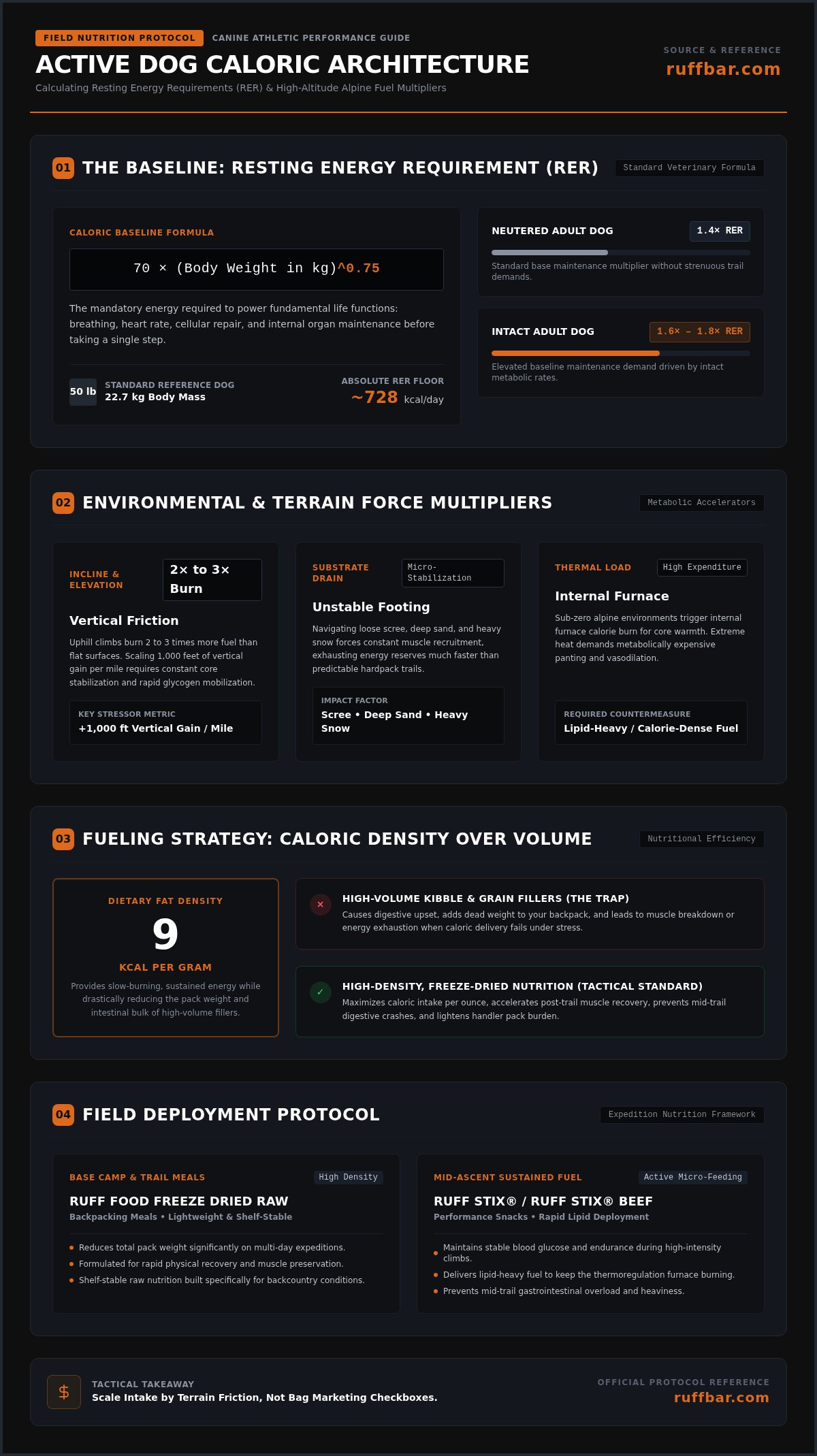
Everything starts with the RER. This is the energy required for basic life functions like breathing, heart rate, and cellular repair. The standard formula used by veterinary professionals is 70 x (body weight in kg)^0.75. For example, a 50-pound (22.7 kg) dog has an RER of approximately 728 calories per day. This is the absolute minimum energy required before they take a single step on the trail. Weight is the primary driver here, but it isn't the only factor. You must adjust this baseline for age and neuter status. Intact adults typically require a 1.6x to 1.8x multiplier just for daily maintenance, while neutered adults often sit closer to 1.4x. Establish this floor before you begin layering on the demands of the trail.
The 'Active' Spectrum: Where Most Owners Get It Wrong
The biggest mistake in canine fueling is the misinterpretation of the "active" label. Generic kibble bags use this term for dogs that play fetch in the backyard for twenty minutes. For a true trail partner, that label is irrelevant. Sedentary lifestyles have skewed our perception of what a dog can and should do. When you transition from a suburban sidewalk to uneven, high-elevation terrain, the metabolic cost spikes. You aren't just looking for more food; you're looking for better fuel. Relying on generic feeding charts for a three-day backpacking trip is a recipe for muscle cannibalization. You must scale your dog's intake based on the actual intensity of the work, not a marketing checkbox on a bag. Knowing how many calories does an active dog need requires a move away from pet-grade logic toward athletic performance standards.
The Performance Multiplier: Factors That Spike Demand
Baselines are just the beginning. Once you step off the pavement, the math changes. You established your starting point using the Resting Energy Requirement (RER) formula, but that number only covers survival. Real-world performance requires multipliers that account for environmental friction. Exactly how many calories does an active dog need when the trail turns vertical? The answer depends on the specific stressors of your mission. Terrain, temperature, and duration act as force multipliers on your dog's metabolism.
Terrain and Elevation: The Invisible Calorie Burner
Steep grades demand massive energy. A five-mile hike on a mountain ridge is not comparable to a five-mile walk in the park. Uphill climbs and uneven ground can burn 2 to 3 times more fuel than flat surfaces. Negotiating loose scree, deep sand, or heavy snow requires constant muscle recruitment and core stabilization. Your dog isn't just moving forward; they are fighting gravity and unstable footing. These micro-adjustments drain glycogen stores rapidly. If you are scaling 1,000 feet of vertical gain for every mile, you must increase your caloric projections significantly to prevent systemic fatigue.
Thermoregulation: Fueling the Internal Furnace
Environment dictates intake. In sub-zero alpine conditions, your dog's body becomes an internal furnace. They burn calories simply to maintain a safe core temperature. Winter expeditions demand a massive increase in dietary fat to provide sustained, slow-burning energy. Heat is equally taxing. Cooling down through panting and vasodilation is a metabolically expensive process. Whether fighting the freeze or managing the heat, the body prioritizes survival over performance. This is why high-altitude athletes require calorie-dense support. Adding a Ruff Stix® Beef snack mid-trek provides the lipid-heavy fuel necessary to keep that furnace burning without weighing down the digestive system.
Duration and mental focus add the final layers. Sustained endurance work for six hours is vastly different from a sixty-minute burst of speed. Technical trails also require intense mental focus. Working dogs navigating complex obstacles or following scents experience cognitive fatigue that mirrors physical exhaustion. Knowing how many calories does an active dog need during these extended missions ensures they return as strong as they started. Precision is mandatory.
How Many Calories Does an Active Dog Need? A Comparison Guide
Theory meets the trail here. You've calculated your baseline. You understand the environmental stressors. Now, you must categorize the mission. Determining exactly how many calories does an active dog need requires matching their workload to a specific performance tier. The Performance Multiplier for working dogs typically ranges from 2.0x to 5.0x RER, depending on intensity and duration. This isn't a suggestion; it's a physiological requirement for sustained output.
Clinical data on maintenance energy requirements for dogs shows that metabolic demand scales exponentially with work. A dog lounging on a rug and a dog hauling a pack over a mountain pass are different biological entities. You must fuel accordingly. Precision is the only standard that matters when you're miles from the trailhead.
Activity Level Breakdown
- Moderate Activity (1.6x to 2.0x RER): This is your Weekend Warrior. Think 1 to 2 hours of vigorous play, long trail walks, or light fetch. They are moving, but they aren't redlining.
- High Activity (2.0x to 3.0x RER): The K9 Athlete tier. This includes daily high-intensity training, agility competitions, or a full day of upland hunting. Their heart rate stays elevated for hours.
- Extreme Performance (3.0x to 6.0x RER): The Thru-Hiker and Sled Dog standard. We are talking about sustained multi-day expeditions covering 15 or more miles per day. This level of exertion demands massive caloric density to prevent muscle wasting.
When you are deep in the backcountry, the stakes are higher. A thru-hiker's partner might need three or four times their normal ration just to stay level. If you don't scale the fuel, the body starts to eat itself. It's that simple. You can't ask for elite performance on a maintenance budget.
Signs Your Dog is Under-Fueled
Don't wait for a total collapse. Watch for the subtle indicators of energy depletion. Lethargy on the trail is the first red flag. If your dog is usually out front but starts lagging behind your heels, they're out of fuel. Slow recovery times after a rest break suggest their glycogen stores are tapped. Look for physical changes. Visible ribs or a sharp "tuck" in the waist that wasn't there forty-eight hours ago indicates a severe caloric deficit. You might also notice a loss of focus or "searching" behavior where the dog ignores commands to scavenge for scraps. They aren't being disobedient; they're starving. Knowing how many calories does an active dog need allows you to intervene before these signs become a medical emergency.
Fueling Strategies: Caloric Density Over Volume
Determining exactly how many calories does an active dog need is only half the battle. The delivery method is where most handlers fail. Traditional advice suggests simply doubling the daily kibble ration for a high-intensity expedition. This is a tactical error. Dogs are metabolic fat oxidizers; they derive the majority of their endurance from animal dietary fats. While humans rely on glycogen from carbohydrates, your dog's engine runs on lipids. Fat provides 9 kcal per gram. Carbohydrates and proteins provide only 4 kcal per gram. To fuel an athlete effectively, you must prioritize caloric density over sheer volume.
High-density fueling ensures your dog stays light and agile. It allows for sustained energy without the physical burden of a distended stomach. Protein remains essential for muscle repair and recovery during rest periods, but fat is the primary driver of propulsion. For more on the technical breakdown of these macronutrients, explore High Protein Dog Energy Bars: The Science of Sustained Adventure Fuel. Precision fueling prevents the mid-trail crash and keeps the mission on track.
The Risk of High-Volume Feeding
Doubling kibble volume introduces significant risks on the trail. Gastric Dilatation-Volvulus (GDV), commonly known as bloat, is a life-threatening condition often triggered by heavy meals followed by high exertion. A full stomach is a liability in rugged terrain. Beyond the medical risk, high-volume feeding is inefficient. Most commercial kibbles contain grain fillers that slow down digestion and divert blood flow from the muscles to the gut. There is also a logistical cost. More volume in means more waste out. On a multi-day trek, every ounce of low-density food adds weight to your pack and increases the amount of waste you must pack out. Efficiency is the standard.
Choosing High-Density Performance Snacks
Effective fueling requires a micro-feeding strategy. Instead of two massive meals, provide frequent, fat-rich snacks throughout the day. This maintains steady blood glucose levels and provides a "slow-burn" energy source that prevents mid-afternoon crashes. Grain-free, meat-first formulas win on the trail because they provide immediate biological utility. When you calculate how many calories does an active dog need, consider the weight-to-calorie ratio of every item in your kit.
Mid-trail fueling should be quick and efficient. You need snacks that offer immediate absorption without the heavy belly feel that hampers movement. Choosing snacks with a high lipid profile ensures your dog can push through the final miles of a technical ascent with total focus. Optimize your dog's trail performance with high-density nutrition.
Ruff Bar: Tactical Nutrition for the Modern K9 Athlete
Nutrition is equipment. On a high-stakes expedition, every gram in your pack must earn its place. You have done the math. You know exactly how many calories does an active dog need to prevent muscle breakdown and systemic fatigue. Now, you need the delivery system. Ruff Bar provides the uncompromising, high-density fuel required for peak performance. We reject fillers. We reject shortcuts. We prioritize the biological needs of the canine athlete over the convenience of the grocery store shelf.
Our formulations use USDA-graded grass-fed meats and whole organic ingredients. This is clean fuel for athletes who refuse to compromise. Whether you are navigating a technical ascent or enduring a multi-day thru-hike, our products provide the energy and propulsion necessary to finish strong. For a deep dive into optimizing your kit, consult The Ultimate Guide to Freeze Dried Raw Dog Food for Backpacking (2026). Precision is the only standard we recognize.
Ruff Food: Built for the Backcountry
Ruff Food Freeze Dried Raw Backpacking Meals are engineered for the weight-conscious explorer. Available in Beef and Duck options, these meals provide maximum caloric density with minimum physical mass. Freeze-drying extracts moisture while preserving the entire nutrient profile, reducing pack weight by up to 75%. Duck offers a high lipid profile for extreme cold or endurance work. Beef provides the high-protein foundation required for muscle repair. Preparation is tactical and fast. Just add water to rehydrate for forced hydration or feed as-is when speed is the priority. It is the gold standard for backcountry fueling.
Ruff Stix®: The Ultimate Trail Reward
Maintaining blood glucose levels requires a consistent micro-feeding strategy. Ruff Stix® are the tactical solution for mid-hike energy. These shelf-stable, moisture-stable sticks come in Bison Pork, Beef, and Pork varieties. We designed them for one-handed administration during technical climbs. You don't need to de-rig your pack to fuel your partner. No grains. No fillers. Zero rendered meals. Just pure protein and fat to keep the internal furnace burning. When you calculate how many calories does an active dog need for a ten-hour day, Ruff Stix® provide the portable, adventure-ready answer. Fuel your partner. Conquer the trail.
Mission Ready: Precision Fueling for the High Trail
Fueling your dog is a tactical decision. You've moved beyond generic pet ownership and into the realm of high-performance partnership. By mastering the RER baseline and applying environmental multipliers, you finally have the answer to exactly how many calories does an active dog need to conquer the most demanding terrain. Stop relying on bulky fillers that weigh down your pack and slow down your dog's engine. Prioritize caloric density through animal fats and high-standard proteins to ensure sustained propulsion and rapid recovery.
Success on the trail depends on preparation. We build our nutrition for those who refuse to compromise. From USDA-graded grass-fed meats to lightweight thru-hiking meals that are grain-free and filler-free, we provide the equipment your dog deserves. Don't let under-fueling be the reason you turn back before the summit. Your partner is an athlete. It's time to fuel them like one.
Fuel your next adventure with Ruff Bar Performance Nutrition
The trail is calling. Make sure your partner is ready to answer.
Frequently Asked Questions
Can I just feed my dog extra kibble on hiking days?
No, simply doubling kibble is inefficient and potentially dangerous. High-volume feeding on the trail increases the risk of gastric torsion, commonly known as bloat. Kibble often contains grain fillers that slow down digestion and divert blood flow from active muscles to the gut. Instead, prioritize caloric density through high-fat, high-protein energy bars or freeze-dried raw meals. This maintains performance without the burden of a heavy belly.
How do I know if I'm overfeeding my active dog?
Monitor their body condition score and energy levels during the mission. Overfed dogs often appear lethargic or sluggish due to the metabolic cost of digesting excessive volume. Look for loose stools or gas, which indicate digestive overwhelm. While determining how many calories does an active dog need, remember that performance is the metric. If they lose their athletic tuck or gain weight, scale back the rations immediately.
What is the best time to feed a dog during a long hike?
Use a micro-feeding strategy throughout the day rather than one large meal. Administer small, high-density snacks like Ruff Stix® every 60 to 90 minutes to maintain steady blood glucose levels. Avoid heavy feeding immediately before or after extreme exertion. Wait at least 30 to 60 minutes after the day's work ends for their body temperature to normalize before providing a larger, nutrient-dense recovery meal.
Do active dogs need more protein or more fat?
Active dogs primarily need more fat for endurance, though protein is essential for recovery. Canine physiology relies on fat oxidation to fuel long-distance movement. Fat provides 9 kcal per gram compared to 4 kcal from protein or carbs. High-quality protein is vital for repairing muscle tissue after the hike. A balanced performance diet must prioritize animal-based fats as the primary energy source for sustained trail work.
How many calories are in a Ruff Bar vs. typical dog treats?
Ruff Food Bars are engineered for high-stakes caloric density, unlike standard treats which are low-calorie rewards. A 1.5 oz Ruff Bar provides concentrated energy from USDA-graded grass-fed meats and organic ingredients. Typical treats are often filled with grains or glycerin and lack the lipid profile necessary for endurance. When calculating how many calories does an active dog need, these bars serve as functional equipment rather than snacks.
What should I pack for a 3-day backpacking trip with my dog?
Pack for maximum density and minimum weight. Prioritize Ruff Food Freeze Dried Raw Backpacking Meals because they reduce pack weight by up to 75% compared to traditional kibble. Include Ruff Stix® for mid-trail fueling and a collapsible bowl for rehydration. Based on the RER formula, pack 2.0x to 3.0x their normal daily calories to account for the increased metabolic demand of the rugged terrain.
Can high-intensity exercise cause my dog to lose weight too fast?
Yes, extreme exertion can lead to rapid muscle wasting if caloric intake doesn't match the burn. Multi-day expeditions can spike energy needs to 5.0x RER or higher. If your dog shows visible ribs or a sharp tuck during a trip, they are in a severe deficit. You must provide high-density fats to prevent the body from cannibalizing its own muscle tissue for survival during high-intensity missions.
Is grain-free better for active dogs with sensitive stomachs?
Grain-free, meat-first formulas are superior for active dogs because they eliminate biological friction. Grains are cheap fillers that can ferment in the gut, leading to gas or loose stools during exertion. For dogs with sensitive systems, a clean profile of grass-fed proteins and organic fats ensures energy goes toward movement. This reduces the risk of digestive distress while maximizing the utility of every calorie consumed on the trail.