
Dog Food Without Fillers: How to Read Labels and Choose Wisely
A short ingredient list doesn’t automatically make a better bowl. Choosing dog food without fillers sounds simple, until unfamiliar names, grain debates, and bold package claims muddy the trail. Wanting clear ingredients and purposeful nutrition makes sense. But “filler” isn’t a regulated nutritional category, and an ingredient’s value depends on the whole formula and your dog’s needs.
This guide explains what people usually mean by filler and how to assess ingredients alongside a food’s nutritional adequacy statement. You’ll learn why grains and carbohydrates aren’t automatically a problem, how to match food to your dog’s age and activity, and where toppers, treats, or portable meals can fit without standing in for a complete diet. A label isn’t a scorecard: the ingredient list, intended use, and nutrition information all matter.
Keep the goal in view: clear sourcing, balanced nutrition, and fuel that suits the dog in front of you. That’s a stronger standard than a short label alone.
Key Takeaways
- Use the nutritional adequacy statement to determine whether a food is intended as a complete meal or for supplemental feeding.
- Read ingredient names and guaranteed analysis as useful clues, not standalone measures of food quality.
- Grains and carbohydrates can serve a purpose in dog food. Judge them in the context of the full formula and your dog’s needs.
- Choose dog food without fillers by weighing life stage, body condition, activity, and feeding role, not by ingredient-list length alone.
- Learn how bars, Stix, freeze-dried backpacking meals, and toppers can fit into active-dog routines without assuming they replace a complete diet.
What Does “Dog Food Without Fillers” Actually Mean?
“Filler” is commonly used as an informal marketing term for an ingredient a buyer believes contributes little nutritional value. It isn’t a formal dog-food label category defined by the FDA or AAFCO. So a “dog food without fillers” claim doesn’t, by itself, tell you whether a food is nutritious, complete, or right for your dog. The more useful question is what each ingredient contributes to the formula.
Is “filler” an official dog food ingredient category?
No. FDA pet-food labeling rules and AAFCO’s model regulations address ingredient names and other label information, but neither defines “filler” as an ingredient class. The FDA oversees pet-food safety; AAFCO develops model regulations and nutrient profiles that states may adopt. AAFCO doesn’t approve or certify individual foods. That’s why a package claim using “filler” is a marketing description, not a substitute for required label details or a nutritional adequacy statement.
This doesn’t mean every ingredient is equally useful, or that any ingredient is automatically useless. Its contribution depends on its purpose, amount in the recipe, digestibility, and how it works with the rest of the formula. For a broader introduction to pet-food ingredients and diet types, see this overview of pet food.
Why ingredient purpose matters more than a buzzword
Ingredients can supply protein, energy, fiber, fats, vitamins, minerals, or other nutrients. A grain, for example, isn’t inherently empty. Depending on the ingredient and recipe, it may provide energy or fiber. The ingredient list shows what’s included, but names alone don’t reveal exact amounts, digestibility, or whether the finished food meets your dog’s needs. A shorter list isn’t automatically better, either.
Try a simple label-reading check. If a food lists oats, don’t decide from that word alone that the ingredient is either a “filler” or a quality marker. Consider its possible role in the formula, then look at the food’s intended use, nutritional adequacy statement, and guaranteed analysis. The full label gives more context than a slogan.
Also separate “without fillers” from other package claims. Grain-free describes the absence of grains, not overall nutritional quality. Natural and organic refer to different ingredient or production claims, not a guarantee that a food is complete and balanced. That statement concerns whether the food is formulated to provide complete nutrition for its stated use. Each claim answers a different question, so read them accordingly.
How to Read a Dog Food Label Beyond the Filler-Free Claim
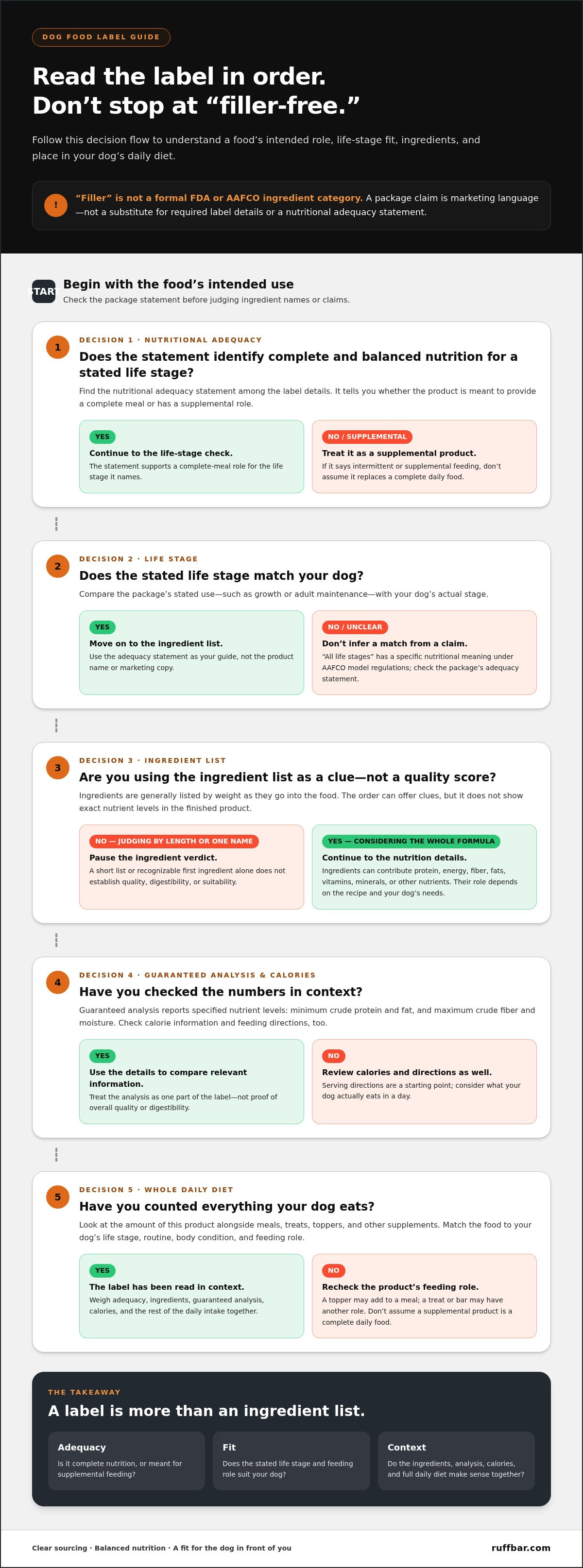
A marketing claim can catch your eye, but it should never replace the nutritional adequacy statement. Read the label in sequence, then match what it says to your dog’s life stage, daily routine, and feeding role.
- Start with intended use and nutritional adequacy. Look for the statement that says whether the food is intended as complete and balanced nutrition for a stated life stage, or for intermittent or supplemental feeding. It’s commonly found with the other label information. The FDA explains key label elements in its pet food labeling guidance.
- Match the life stage. Compare the label’s stated use, such as growth or adult maintenance, with your dog’s actual stage. “All life stages” has a specific nutritional meaning under AAFCO model regulations. Rely on the package’s adequacy statement rather than assuming a product qualifies based on its name or marketing.
- Check the ingredient list. Ingredients are generally listed by weight as they go into the food. That order can offer clues, but it doesn’t tell you exact nutrient levels in the finished product. Don’t treat a recognizable first ingredient or a short list as a complete quality score.
- Review guaranteed analysis and calories. Guaranteed analysis reports specified nutrient levels, including minimum crude protein and fat and maximum crude fiber and moisture. Use it to compare relevant information across foods, not as proof of overall quality or digestibility. Check calorie information and feeding directions, too.
- Account for the whole daily diet. Consider how much of the product your dog will eat alongside meals, treats, toppers, and other supplements. Don’t mistake a supplemental product for a complete daily food unless its label supports that role.
Check adequacy before the ingredient pitch
Complete daily food and supplemental products serve different jobs. A topper may add to a meal; a treat or bar may have another feeding role. The package’s exact statement matters. Don’t assume that a product meets a nutritional standard just because it’s labeled “premium,” “natural,” or “filler-free.” For active dogs, Ruff Bar’s nutrition options for dogs include different product formats. Read each product’s label to understand its intended role.
Read the numbers in context
Serving directions are a starting point, not a reason to ignore your dog’s body condition or total intake. Compare the calorie content and recommended amount with what your dog actually eats in a day. Then weigh the ingredient list and guaranteed analysis alongside the adequacy statement. That’s a more useful label check than choosing dog food without fillers by slogan alone.
Are Grains and Carbohydrates Always Fillers in Dog Food?
No. Grains and other carbohydrate sources aren’t automatically fillers or harmful. Their role depends on the ingredient, the amount used, and the formula as a whole. Carbohydrates can provide energy, while fiber from some ingredients can support normal digestive function. Grains may also contribute nutrients and help shape a food’s texture. Grain-free doesn’t automatically mean healthier, and it isn’t necessary for every dog.
No single ingredient label proves a food is right for every dog. Suitability depends on the complete nutrient profile, feeding role, life stage, health needs, activity, and individual tolerance. For background on how nutrient needs vary, consult the Merck Veterinary Manual’s overview of the nutritional requirements of dogs.
What grains and carbohydrates can contribute
Think function, not category. A carbohydrate source may supply usable energy; a fiber-containing ingredient may contribute to digestive function; and ingredients can help create a consistent food texture. Those roles don’t make every recipe suitable, but they show why labeling an entire class of ingredients “filler” oversimplifies the decision. Evaluate the food’s nutritional adequacy and intended use alongside its ingredients.
Ingredient type | Possible role | Ask about the whole formula
Grains | May provide energy, fiber, or other nutrients, depending on the grain and recipe. | Does the food suit my dog’s needs and stated life stage?
Other carbohydrate sources | May supply energy or contribute to texture and formulation. | How does this fit with the food’s overall nutrient profile and feeding directions?
Fiber-containing ingredients | May contribute fiber to the diet. | Is the complete food appropriate for my dog’s digestion and daily feeding role?
When a specific ingredient needs closer attention
A suspected food sensitivity calls for an individual assessment, not a broad ban on grains or carbohydrates. Signs such as itching or digestive upset can have different causes, so removing an ingredient on your own may not identify the trigger. If symptoms persist, a condition has been diagnosed, or an elimination diet is being considered, work with a veterinarian on the appropriate plan.
Choosing dog food without fillers can be one preference in your label review, but it isn’t a treatment plan. Let your dog’s specific needs, the food’s nutritional adequacy, and professional guidance steer the decision.
How to Choose Dog Food Without Fillers for Your Dog’s Real Needs
Choose by function first, ingredient priorities second. Start with your dog’s life stage, then consider body condition, activity, feeding role, and the ingredients you value. This keeps “filler-free” from becoming a shortcut that overlooks what your dog actually needs.
Match the food to life stage, activity, and feeding role
- Life stage: Check that the food’s stated nutritional use suits your dog’s age and life stage.
- Body condition: Consider whether your dog needs to maintain, gain, or lose weight. Use feeding directions as a starting point, then account for your dog’s condition and total daily intake.
- Activity: Look at the real workload, not just the label “active.” A long hike, regular training, and a mostly relaxed day place different demands on a dog. More movement can change energy needs, but there’s no single calorie amount that fits every dog.
- Feeding role: Decide whether you’re choosing a complete main meal or an addition such as a treat, bar, Stix, or topper. A product intended to supplement meals doesn’t automatically replace complete food.
- Ingredient priorities: Once the role and needs are clear, compare ingredient information, calorie details, and serving guidance where labels provide comparable information.
For an active dog, account for the whole day’s intake. Food, training rewards, bars, toppers, and portable meals can all contribute calories. If activity increases for a trip or training block, reassess the overall feeding plan rather than adding products by guesswork. Follow each product’s label for its intended use and serving directions.
Use ingredient priorities without overbuying claims
Look for clear ingredient information and a feeding role that fits the job. A high-protein bar might suit a different moment than a main meal; a topper adds to a meal rather than taking its place unless its label says otherwise. Compare calorie information and serving instructions where available, then consider how each item fits into the dog’s total diet. Short ingredient lists and “natural” or “filler-free” claims can guide your questions, but they can’t make the decision for you.
For dogs with medical conditions, individualized nutrition needs, or a major diet change ahead, involve your veterinarian. Their guidance can help align the food choice with the dog’s health and activity instead of relying on broad claims. Ready to explore purposeful nutrition for active dogs? Explore Ruff Bar’s dog nutrition options.
Ruff Bar Nutrition Options for Active Dogs Seeking Food Without Fillers
Ruff Bar offers nutrition options for dogs built for movement, travel, and time outdoors. Its formulas use USDA-graded grass-fed meats and whole organic ingredients without fillers. That ingredient approach gives you a starting point, but the right choice still depends on your dog’s needs and the product’s stated feeding role.
Match Ruff Bar formats to the job at hand
Different formats fit different moments in an active dog’s routine. Read the package directions and nutritional adequacy statement to understand how an item fits into meals.
- Food bars: Ruff Food Bars are portable options for active-dog routines. Use them according to the label rather than assuming a bar replaces a complete daily food.
- Stix: Ruff Stix® varieties, including beef, pork, and bison pork, offer another convenient format. Follow each product’s label for its intended use and serving guidance.
- Freeze-dried backpacking meals: Ruff Food Freeze Dried Raw Backpacking Meals in beef and duck are portable meal formats for outings. Check the specific package to understand its intended feeding role and how it fits with your dog’s regular diet.
- Toppers: Ruff Bar Functional Nutrition Toppers and Ruff Bar Pure Blend Toppers are additions to a feeding routine. Don’t treat a topper as a complete meal unless its label specifically supports that use.
Choose with ingredient transparency and purpose in mind
The same label-reading habits apply here: check the ingredient list, intended use, feeding directions, and nutritional adequacy statement. “Without fillers” can describe an ingredient approach, but it doesn’t tell you by itself whether a product is complete and balanced. Use the individual product label to understand its role, then account for its calories and serving guidance as part of your dog’s total daily intake.
For a dog with a demanding routine, bars, Stix, portable meals, or toppers may serve different purposes. Pick the format that matches the moment, whether that’s a trail day or an addition to the usual bowl. Keep the main diet and the product’s stated role clear.
Explore Ruff Bar’s dog nutrition products and find a format that fits your next outing.
Choose Fuel That Fits Your Dog’s Next Move
“Filler-free” is a starting point, not a nutrition score. Ingredient roles matter, grains and carbohydrates aren’t automatically harmful, and the label’s nutritional adequacy statement helps clarify whether a product is intended as a complete meal or a supplement. To choose dog food without fillers wisely, match its stated feeding role and nutrition information to your dog’s life stage, condition, and activity.
Ruff Bar’s formulas use USDA-graded grass-fed meats and whole organic ingredients without fillers. The range includes bars, Stix, freeze-dried backpacking meals, and nutrition toppers, with each format serving a different purpose. Read the individual product label to see how it fits your dog’s routine and total diet.
Explore Ruff Bar nutrition for active dogs and find options for your next day on the move. Clear labels. Purposeful choices. Here’s to many more miles together.
Frequently Asked Questions
What does “dog food without fillers” mean?
“Dog food without fillers” usually means the maker or shopper wants to avoid ingredients they consider to add little nutritional value. But “filler” is commonly an informal marketing term, not a complete measure of nutrition. Assess an ingredient’s purpose alongside the adequacy statement, intended feeding role, and your dog’s needs. Don’t assume an ingredient is worthless based on its name. Review the package wording and applicable FDA or AAFCO guidance.
Is dog food without fillers better for dogs?
Not necessarily. A “without fillers” claim alone can’t establish nutritional quality or suitability for a particular dog. Compare the food’s adequacy statement, intended life stage, calorie information, and ingredient transparency, then consider your dog’s body condition and routine. No ingredient claim guarantees better health. If your dog has a diagnosed condition, persistent symptoms, or specific dietary needs, ask your veterinarian for individualized guidance before changing foods.
Are grains fillers in dog food?
No. Grains aren’t automatically fillers. Depending on the ingredient and recipe, they may contribute nutrients, energy, or fiber, or serve a role in the food’s formulation. A grain-free label doesn’t by itself prove a food is healthier, just as grain inclusion doesn’t determine overall quality. Evaluate the whole formula, its intended use, and your dog’s needs rather than relying on a grain-free slogan.
Can dogs eat food that contains corn or other grains?
A food’s suitability can’t be determined from the presence of corn or another grain alone. Assess the full label, including the nutritional adequacy statement, intended feeding role, and directions, then consider your dog’s individual needs. If your dog has a diagnosed sensitivity or ongoing symptoms, seek veterinary guidance instead of removing ingredients based on a blanket rule. Ingredient presence alone doesn’t diagnose a problem.
How can I tell if dog food is complete and balanced?
Look for the nutritional adequacy statement on the package. It indicates whether the food is intended to provide complete and balanced nutrition for a stated life stage or is for intermittent or supplemental feeding. AAFCO model terminology includes statements about nutritional adequacy, but AAFCO doesn’t approve or certify individual foods. Don’t assume treats or toppers replace a complete diet, and don’t infer a product’s adequacy without label support.
Does a short ingredient list mean dog food is healthier?
No. Ingredient-list length isn’t a standalone quality test. A short list doesn’t show whether the food’s nutrient profile is adequate, whether it’s intended as a complete diet, or whether its feeding directions suit your dog. Ingredient transparency can help you understand what’s included, but it doesn’t guarantee better outcomes. Compare the full label and feeding role, then judge the food against your dog’s individual needs.
Can active dogs use toppers or freeze-dried meals as their only food?
Only if the specific product’s label says it’s nutritionally adequate as a sole diet for your dog’s life stage. Words like “meal” or “topper” alone don’t establish that. Ruff Bar’s toppers are additions to a feeding routine, while its freeze-dried backpacking meals have product-specific labels that explain their role. For heavy activity, a medical concern, or a major diet change, ask your veterinarian for an individualized feeding plan.