
Dog Food for Sled Dogs: Nutrition, Feeding, and Trail Fuel in 2026
The right dog food for sled dogs depends on the work ahead, the weather, and the individual dog. A short training run, a long outing, and a rest day do not call for the same fueling assumptions.
High-fat, high-protein advice can be hard to apply without context. Training demands, body condition, meal timing, and access to water all matter. This guide explains how to assess those factors, plan meals around work, and make gradual adjustments as a dog’s routine changes. It also covers where portable options fit: Ruff Bar’s bars, Stix, and freeze-dried meals can complement an established feeding plan, while toppers and supplements are additions, not automatic replacements for a complete daily ration.
Key Takeaways
- Choose dog food for sled dogs according to workload, from sustained endurance runs to lighter recreational outings.
- Consider protein, fat, carbohydrates, and water as parts of a feeding plan, not as a fixed formula for every dog.
- Distinguish complete daily food from supplemental ingredients, portable meals, and treats by checking each product’s intended role.
- Build a practical routine around the dog’s usual needs, work demands, food and water preparation, observation, and gradual adjustments.
- Ruff Bar’s portable and supplemental nutrition products can fit alongside an established complete daily diet.
Dog food for sled dogs: why workload changes the nutrition equation
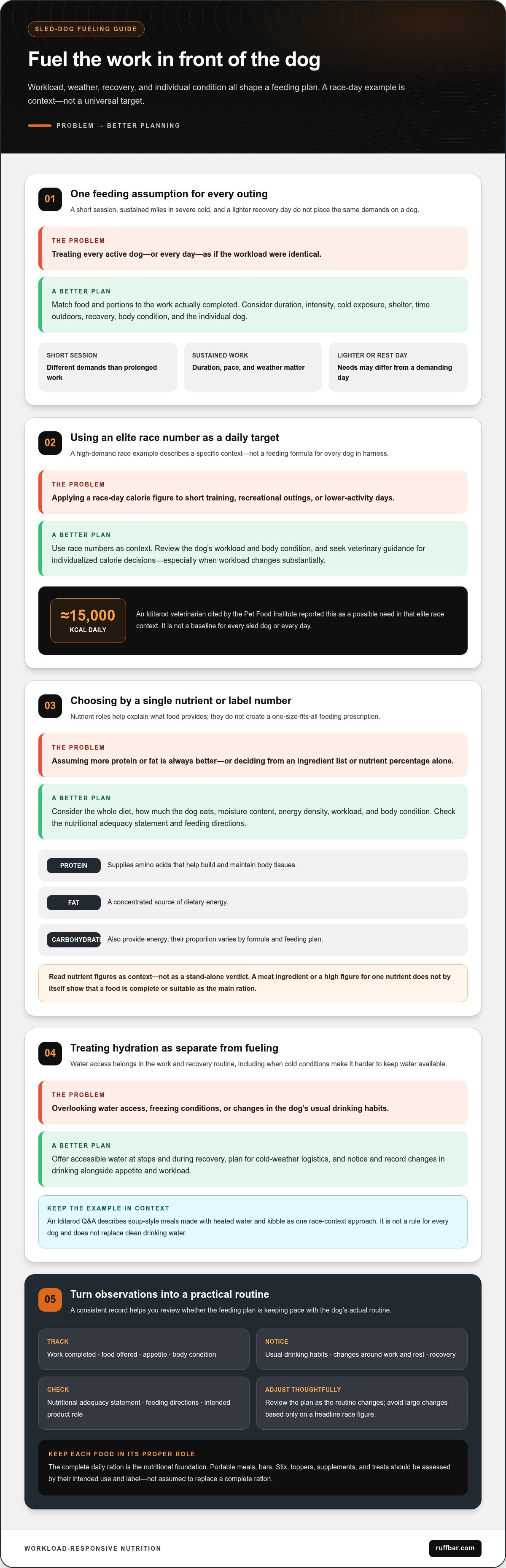
Sled-dog nutrition is a workload-responsive plan, not a fixed recipe. A team covering sustained miles in severe cold faces different demands from a dog completing a short training session or joining a recreational outing. Match food and portions to the work the dog actually does, rather than treating every active dog like an elite racer.
Energy needs vary with workload, environment, body condition, and the individual dog. That is the practical starting point. Race-day feeding examples provide context, but they are not automatic targets for every dog in harness.
What makes a sled dog’s energy needs different?
Duration and intensity shape how much fuel a dog uses. A long, steady run places different demands on the body than a brief, fast session. Cold exposure matters too: conditions, shelter, and time spent working outdoors all affect feeding considerations. Recovery counts as well. Needs on a demanding workday may differ from those on a lighter day afterward.
Calories measure the energy food provides. They can help you compare intake with workload, but there is no universal daily target for every sled dog. Body size alone cannot settle the question. Dogs of similar size may differ in duration of work, pace, condition, and individual response.
Track the work completed, food offered, appetite, and body condition over time. A consistent record helps show whether the feeding plan is keeping pace with the dog’s routine, rather than relying on a number borrowed from another team or event.
Why one race-day calorie figure does not fit every dog
The Iditarod veterinarian cited by the Pet Food Institute has reported that dogs in that race context may need approximately 15,000 kcal daily. That figure reflects the demands of an elite race. It is not a baseline for shorter training runs, occasional recreational work, or a lower-activity day.
Race duration, sustained effort, weather, and a dog’s individual condition all shape that context. A training schedule may include hard sessions and easier days, so feeding decisions should reflect that variation instead of applying a race figure across the week. A short outing does not automatically call for the same intake as prolonged work in harsh conditions.
Use race numbers as context, not as a ration calculator. For individualized calorie decisions, assess body condition alongside workload and seek veterinary guidance. If a dog’s workload changes substantially, review the feeding plan rather than making a large adjustment based on a headline figure. The goal is a measured approach built around the dog in front of you.
How protein, fat, carbohydrates, and water support sled-dog work
Protein, fat, carbohydrates, and water each have a role in a working dog’s diet. Understanding those roles helps you assess food choices, but nutrient functions do not make a dog-specific feeding prescription. Nutrient roles explain what food can provide; workload, the complete diet, and the individual dog guide what to feed.
Protein and fat: useful context, not a one-size-fits-all ratio
Protein supplies amino acids that help build and maintain body tissues. Fat is a concentrated source of dietary energy. Both belong in the context of a complete diet, where nutrients work together to meet a dog’s needs. More protein or fat is not automatically better; consider the whole diet and match it to the dog’s work and condition.
Percentages on a label need interpretation. The amount a dog eats matters alongside the listed nutrient profile, and comparisons can mislead when foods differ in moisture content or energy density. An ingredient list naming meat, or a high figure for one nutrient, does not by itself establish that a food is complete or suitable as the main ration. Check the nutritional adequacy statement and feeding directions, then consider the full profile.
Carbohydrates also provide energy and can contribute to a diet. Their proportion varies by formula and feeding plan, so it is too simplistic to assume a working dog cannot use them. Ask how the whole food supports the dog’s needs, rather than assuming one macronutrient is always right or wrong. For dog food for sled dogs, read nutrient figures as context, not as a stand-alone verdict. Ruff Bar’s portable nutrition for active dogs can complement an established complete ration. Follow each product label for its intended use.
Hydration belongs in the fueling plan
Water access matters during work and afterward. Include opportunities to drink in the routine, and plan for cold-weather logistics so water remains available. Offer accessible water at stops and during recovery, and account for freezing conditions. Track your dog’s usual drinking habits alongside appetite and workload; a notable change is useful information, not something to dismiss.
An Iditarod Q&A describes soup-style meals made with heated water and kibble as one race-context approach to encouraging fluid intake. That example reflects a specific racing setting. It is not a rule for every sled dog, a substitute for clean drinking water, or a reason to change a dog’s diet without considering the full plan.
Keep the routine practical: offer water regularly, notice what your dog drinks, and record changes around work and rest. If drinking patterns shift in a concerning way, seek veterinary advice. Water access, trail conditions, and the dog’s response all belong in the feeding plan.
Complete meals, trail food, and treats: choosing the right role
A feeding plan works best when each food has a clear job. The daily ration provides the nutritional foundation; additions and trail options fit around it. A bar, a meat-based ingredient, or a freeze-dried format does not prove that a product is complete. Check the label’s nutritional adequacy statement and intended feeding directions before deciding how it fits.
| Food type | Primary role | How to use it in the plan |
|---|---|---|
| Complete daily food | Provides a full diet for the stated life stage. | Use as the routine foundation, following label directions and adjusting with professional guidance. |
| Supplemental ingredients | Add to or complement a meal, as directed. | Keep additions in their intended supporting role; they do not automatically replace complete food. |
| Portable meals | Offer a convenient format for outdoor logistics. | Use according to the product label. Do not assume a backpacking meal is a complete daily ration. |
| Treats | Serve as rewards or occasional extras. | Keep treats distinct from meals and follow their label directions. |
What belongs in the dog’s everyday feeding foundation?
Use a complete diet as the nutritional foundation unless advised otherwise. Choose food appropriate to the dog’s life stage and follow its feeding directions. Activity can affect the overall plan, but adding a single ingredient or relying on a high-protein product does not make a diet complete.
Ingredient lists and product formats tell only part of the story. Look for the nutritional adequacy statement, intended use, and feeding directions. If you are considering a homemade recipe or a diet built around single ingredients, get veterinary guidance on formulation rather than assuming it supplies every required nutrient.
Individual needs differ, so treat the label as a starting point, not a substitute for advice tailored to your dog. Discuss feeding decisions with your veterinarian, especially when the dog’s work, condition, or life stage calls for a more specific approach.
When can portable trail nutrition fit?
Portable options can make it easier to carry food for training and outdoor outings. They complement the dog’s usual meals; convenience alone does not make them interchangeable with a complete daily diet. Plan what to bring around the outing and the established feeding routine, then use each product according to its label.
Ruff Bar offers food bars, Stix, and freeze-dried backpacking meals, along with toppers and supplements. Check the specific label for feeding directions and whether the product is intended as a treat, topper, or supplemental feed. Do not infer meal status from a meat source or the word “meal” in a product category. That distinction keeps trail convenience in its proper role and the dog’s everyday nutrition on a clear footing.
How to adapt a sled-dog feeding plan before, during, and after work
A reliable feeding plan is built through observation, not guesswork. As training demands shift, establish what is normal, prepare for the work, then assess how your dog responds. Keep changes gradual and follow food labels rather than improvising portions or timing.
- Establish a baseline. Record the dog’s usual food, feeding routine, appetite, water intake, stool, and body condition during a stable period. This gives you a reference point before work intensity or duration changes.
- Map the workload. Note the type and duration of each session, pace or effort where useful, weather, and time spent in cold conditions. Record a short training run and a sustained outing separately, even if they happen on the same trail.
- Prepare food and water. Pack the dog’s usual food and water for the outing, along with any supplemental products you already use according to their labels. Fit feeding into the day based on the dog’s established routine and individual tolerance.
- Observe the response. Track what food is offered and eaten, drinking, appetite, stool, energy, and how the dog appears to recover. Look for patterns across sessions rather than drawing conclusions from one meal or one day.
- Review and adjust carefully. Compare the records with body condition and workload. If a diet change is needed, make it gradually; the research guidance recommends allowing four to six weeks for a transition. Follow label directions and seek veterinary advice for individualized decisions.
Build a routine around training and work
Keep the log simple enough to use consistently. A daily entry can include work duration and conditions, food offered, what the dog ate, and water intake. Add notes about feeding timing and the dog’s response. This can help distinguish a change that followed a harder session from one that also appears on rest days.
There is no single pre-work or post-work schedule that fits every dog. Feeding portions and timing should reflect the individual dog’s tolerance and established guidance. Avoid abrupt meal changes just because a session ran longer than planned. For dog food for sled dogs, a routine that is recorded and reviewed is more useful than a rigid schedule detached from the dog’s work.
Monitor the dog, not just the food label
A label helps guide feeding, but it cannot tell you how an individual dog is responding. Watch appetite, stool, drinking, energy, recovery, and body condition over time. A change can have more than one cause, so do not self-diagnose or assume that changing food alone will address it.
If changes in appetite, digestion, hydration, energy, or body condition persist or concern you, seek veterinary assessment. Keep your notes handy; a clear record of work, food, water, and observed changes can support a more informed conversation. For portable additions to an established feeding routine, explore Ruff Bar’s nutrition for active dogs.
Portable nutrition for sled dogs: where Ruff Bar fits
Food belongs on the trail-planning gear list. Ruff Bar makes nutrition products for active dogs, including food bars, Stix, freeze-dried meals, toppers, and supplements. These portable options can support feeding logistics on training days and outdoor outings, but they do not replace a complete daily sled-dog diet. Keep the dog’s established ration as the foundation, then use other products only in their intended role.
Match a portable product to the moment
Choose by purpose, not just format. Food bars and Stix are compact options to consider for outings; check each label for feeding directions and intended use. Ruff Bar’s freeze-dried meals offer another portable format, but a product name or protein source alone does not establish that it is a complete ration. Use the label to understand how it fits your plan.
Toppers and supplements have a supporting role. They should not automatically replace regular food, and a supplement is not a substitute for an individually appropriate diet. When packing a product for a longer outing, account for what the dog normally eats and how the item is meant to be fed. Do not assume a treat, topper, or supplemental product can serve as a meal.
Prepare a practical, label-led fueling kit
Pack familiar food, measured portions, and access to water. For a training run, that could mean carrying the dog’s usual food plan plus a portable option you have already introduced during an easier outing. Trying a new food in a familiar routine gives you a chance to observe whether the dog accepts it and how it fits before a demanding trip.
Before packing any Ruff Bar product, read its label for intended use and feeding directions. Keep the original packaging or relevant instructions accessible, and plan how the product complements the dog’s complete daily food rather than displacing it. If the dog follows a specific feeding plan, account for additions as part of the overall routine.
Build the kit around the dog, not the other way around. A portable product can make food easier to carry, but convenience does not prove nutritional completeness or guarantee a particular result. Choose the role first, follow the label, and keep water in the plan. For dog food for sled dogs, that distinction keeps trail fuel practical without confusing supplemental nutrition with the daily foundation.
Explore Ruff Bar’s active-dog nutrition range to find portable and supplemental options for your outings, then use each product according to its label.
Set your next trail plan in motion
Let changes in training or trail conditions prompt a fresh look at the routine. Keep notes from your next outing, then use what you observe to guide feeding decisions with your veterinarian. This steady, dog-by-dog approach is more useful than chasing a universal formula for dog food for sled dogs.
For portable options that fit alongside an established daily diet, Ruff Bar’s active-dog range includes bars, Stix, freeze-dried meals, toppers, and supplements. Ruff Bar’s formulas use USDA-graded grass-fed meats and whole organic ingredients without fillers. Use each product according to its label and intended role.
Explore Ruff Bar nutrition for active dogs and choose a practical addition for your next outing. Build the plan around your dog, pack with purpose, and keep moving together.
Frequently Asked Questions
Can sled dogs eat regular dog food?
Some working dogs eat commercial food, but whether it suits a sled dog depends on its nutritional adequacy, workload, and individual needs. Check that the label identifies the food as complete for the dog’s life stage, then follow its feeding directions. Race-dog diets are not universal templates. Before replacing an established food or adding a new one, discuss the change with your veterinarian, especially if the dog’s training demands are increasing.
How much food does a sled dog need each day?
There is no single portion that fits every sled dog. Body size, work, weather, food energy density, and individual metabolism all affect the amount needed. A figure such as 15,000 kcal belongs to the Iditarod race context and the dogs competing there, not as a daily target for every working dog. Use label guidance, monitor body condition over time, and ask your veterinarian to help determine an individual ration.
Should sled dogs eat more fat in cold weather?
Dietary fat is energy-dense, but that does not mean every dog needs extra fat in cold weather. A Wilderness Classroom account describes one kennel adding lard during extreme cold; it is an example from that kennel, not a prescription for other dogs. Adding ingredients can change the overall diet. Consider the dog’s full food plan and workload, and seek veterinary guidance before increasing fat or making other substantial diet changes.
Can sled dogs eat during a long run?
Some feeding plans include food during extended work, but the approach depends on the dog, event plan, workload, and handler’s established routine. Iditarod checkpoint practices reflect a specific race setting, not a universal schedule for every trail outing. Before a demanding trip, plan familiar food and water access, and avoid experimenting with unfamiliar products on the trail. Discuss feeding during prolonged work with your veterinarian.
How can I encourage a sled dog to drink in cold weather?
Provide appropriate access to water and observe how much your dog drinks during and after work. Cold conditions can complicate water access, so include it in outing logistics and check that water remains available. An Iditarod Q&A describes soup-style meals as one race-specific approach to fluid intake, not a required method for every dog. Do not rely on a particular food to prevent dehydration; ask your veterinarian about concerns or notable changes.
What should I do if my sled dog refuses food after working?
Record when the refusal happened, the work completed, food offered, water intake, and any other changes. One missed meal does not identify the cause, so do not force a new food or try to diagnose the problem yourself. Offer the dog’s familiar food according to its usual plan and keep observing. Seek veterinary guidance promptly if refusal persists, happens again, or occurs with other concerning changes.