
Complete and Balanced Freeze-Dried Dog Food: A Buyer’s Guide
Could a lightweight freeze-dried pouch be your dog’s whole meal, or just a topper? The format alone can’t answer that. To identify complete and balanced freeze-dried dog food, look for the nutritional adequacy statement and the life stage it’s intended for.
That label-first approach matters whether you’re choosing food for a growing puppy, an adult dog, or a travel-ready routine. Feeding directions and calorie information help you work out how much to serve and whether a product is meant as a meal, a mixer, or an occasional extra. Comparing freeze-dried food with kibble, raw diets, and toppers is easier when you separate nutritional role from practical details like storage and preparation.
This guide explains what to check, how to compare formats, and how to match a product to your dog’s needs. You’ll also learn how to distinguish a complete meal from treats and toppers by reading the label and feeding directions. Ruff Bar sells Beef and Duck freeze-dried backpacking meals for active-dog routines. Use each product’s label to confirm its feeding role and directions.
Key Takeaways
- Freeze-drying describes how food is processed; the nutritional adequacy statement shows whether it’s intended as a complete diet.
- Use the life-stage statement, feeding directions, and calorie information to assess whether a complete diet fits your dog’s needs.
- Compare freeze-dried food with kibble, canned food, and raw formats by considering storage, portioning, and serving routine, not format alone.
- Match the stated life stage and feeding role to your dog before weighing recipe features, activity, appetite, or veterinary-directed dietary needs.
- Ruff Food Freeze Dried Raw Backpacking Meals Beef and Duck offer portable meal options for active-dog routines. Follow each product’s label for its intended feeding role.
What Does Complete and Balanced Freeze-Dried Dog Food Mean?
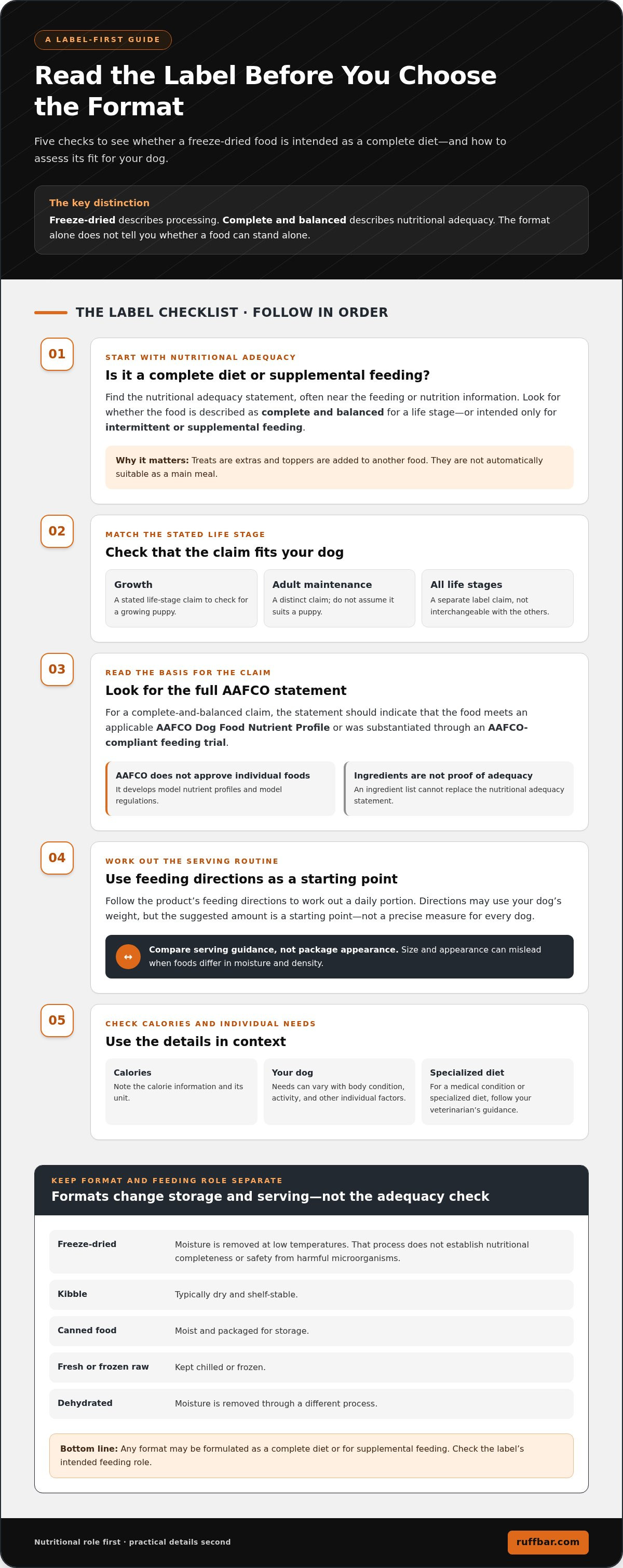
Freeze-dried describes a food’s format. Complete and balanced describes its nutritional adequacy. The terms aren’t interchangeable. A food can be raw or freeze-dried without being designed to supply all the nutrients a dog needs as a sole diet.
A complete diet is intended to provide the nutrients needed for its stated life stage when fed as directed. Treats are extras, toppers are added to another food, and supplements provide particular nutrients or ingredients. Using a treat or topper as a main meal could leave gaps unless the label specifically says it’s complete and balanced for that use.
What does a nutritional adequacy statement tell you?
Look for a nutritional adequacy statement on the package, often near the feeding or nutrition information. It says whether the food is intended as a complete diet or for supplemental feeding, and identifies the life stage it’s meant to support, such as growth or adult maintenance.
For a complete-and-balanced claim, the statement should indicate that the food meets an applicable AAFCO Dog Food Nutrient Profile or was substantiated through an AAFCO-compliant feeding trial. AAFCO develops model nutrient profiles and model regulations; it doesn’t approve individual products. Ingredient lists and sourcing claims can tell you what’s in a recipe, but they don’t replace the adequacy statement.
How is freeze-dried food different from other food formats?
Freeze-drying removes moisture at low temperatures. That describes how the food is processed, not whether it’s nutritionally complete or safe from harmful microorganisms. Check the product label for its intended feeding role, whatever the format.
Kibble is typically dry and shelf-stable; canned food is moist and packaged for storage; fresh or frozen raw food is kept chilled or frozen; and dehydrated food has moisture removed through a different process. Each format can have a different storage and serving routine, but none automatically establishes nutritional adequacy. For a broader overview of dog food formats and nutrition, compare the format with the label’s claim rather than judging by appearance or processing method.
This distinction is especially useful when choosing complete and balanced freeze-dried dog food. Read the adequacy statement first, then match its life stage and feeding role to your dog. For trail-specific planning, see the freeze-dried raw dog food backpacking guide.
How to Read a Freeze-Dried Dog Food Label for Nutritional Adequacy
Use the label as a checklist, not a sales pitch. Before choosing a complete diet, review the nutritional adequacy statement, life stage, feeding directions, and calorie information. Together, these details tell you whether the food is intended to stand alone and how to serve it.
Which label statements and life stages should you check?
Start with the nutritional adequacy statement, usually printed with the feeding or nutrition information. Look for language saying the food is complete and balanced for a specific life stage, or that it’s intended only for intermittent or supplemental feeding. The U.S. Food and Drug Administration explains what complete and balanced means and how nutrient profiles and feeding trials can support the claim.
Next, match the stated life stage to your dog. Growth, adult maintenance, and all life stages are different claims, not interchangeable labels. Don’t assume a product intended for adult maintenance is suitable for a puppy. If the package refers to an AAFCO nutrient profile or feeding trial, read the full statement to understand the basis for the claim.
Be wary of “AAFCO-approved” wording. AAFCO develops model nutrient profiles and regulations, but it doesn’t approve individual foods. An ingredient list shows what goes into a recipe, with ingredients listed in descending order by weight. It can’t, by itself, prove the finished food provides all required nutrients in appropriate amounts. The adequacy statement is the key label information to assess.
What do feeding directions and calorie information add?
Once the life stage fits, use the feeding directions to work out a daily portion. Directions may base amounts on a dog’s weight, but treat them as a starting point rather than a precise measure for every dog. Check the calorie information, note the unit, and compare serving guidance between foods. Package size and appearance can mislead, especially when formats differ in moisture and density.
Your dog’s needs can vary with body condition, activity, and other individual factors. For a medical condition or specialized diet, follow your veterinarian’s guidance rather than relying on a general feeding chart.
Apply these checks to any complete and balanced freeze-dried dog food you’re considering. Ruff Bar sells freeze-dried meals for active-dog routines. Use each product’s label to understand its feeding role and directions.
Freeze-Dried Dog Food Compared With Kibble, Canned, and Raw Formats
Choose by the job the food needs to do and the routine you can sustain. Format affects storage and serving; the label establishes whether a food is intended as a complete diet. Freeze-dried meals, kibble, canned food, and raw food may each be formulated as a complete diet or for supplemental feeding. The format alone doesn’t decide.
What are the practical trade-offs between food formats?
Follow the package directions for storage, portioning, and preparation. Instructions vary by product, even within the same format. The FDA’s explanation of the nutritional adequacy statement clarifies how to tell whether a food is intended to be fed as a sole diet.
| Format | Adequacy check | Storage and serving routine | Portioning |
|---|---|---|---|
| Freeze-dried | Read the adequacy statement and intended life stage. | Follow package storage and preparation instructions. Serving steps vary by product. | Use its feeding directions and calorie information; don’t judge by pouch size. |
| Kibble | Check the statement and life stage, just as you would for other formats. | Follow package storage directions; portions are typically served dry. | Measure according to the label and account for calories. |
| Canned | Check whether it’s a complete diet or intended for supplemental feeding. | Follow the label’s storage directions, including after opening. | Use serving guidance and calorie information to compare portions. |
| Fresh or frozen raw | Assess the package’s adequacy claim and life stage rather than assuming raw means complete. | Follow the product’s storage and serving directions. | Use the specific feeding guide and calorie details provided. |
These are comparison points, not guarantees about every product. Freeze-dried foods may have specific preparation instructions, so follow the label rather than assuming they’re served dry or prepared the same way. For complete and balanced freeze-dried dog food, verify the adequacy claim first, then decide whether its storage and serving routine fits your day.
How do you compare meals, treats, and toppers fairly?
Compare products by intended role before weighing ingredients or appearance. A complete meal is meant to provide a dog’s diet when fed as directed. Treats are extras; toppers are added to another food. Unless the label identifies a treat or topper as complete and balanced for the relevant life stage, don’t assume it can replace a meal. A bold ingredient list doesn’t change its feeding role.
If you’re choosing an extra for rewards rather than a meal, see the freeze-dried treats for dogs guide. For every format, match the intended feeding role to your dog’s routine.
How to Choose a Complete Freeze-Dried Food for Your Dog
Start with suitability, not flavor or ingredient claims. The right choice must match your dog’s life stage and your feeding routine, and its label must support the intended role. Only then compare recipes, sourcing, and convenience. This order keeps appealing package language from distracting you from the essentials.
Which dog-specific needs should shape your choice?
Work through your dog’s needs before comparing products:
- Life stage: Match the package’s adequacy statement to your dog’s stage. A food labeled for adult maintenance isn’t automatically suitable for growth.
- Body condition and appetite: Consider whether your dog eats reliably and how the feeding directions fit the portions they’ll need.
- Routine and activity: Think about where and when you’ll serve the food. A highly active dog may have a different routine, but activity alone doesn’t establish a need for a specific recipe or prove a food is nutritionally adequate.
- Restrictions: Take known sensitivities, diagnosed conditions, and veterinary-directed dietary needs seriously.
For puppies, dogs with diagnosed health conditions, or dogs who need a specialized diet, get veterinary guidance before making a choice. Keep elimination diets and medically directed feeding plans under that guidance. Ingredient preferences can help narrow options, but they shouldn’t override the diet your veterinarian recommends.
What practical details matter before switching food?
Check the product’s directions before serving. Review portion guidance, calorie information, storage instructions, and preparation steps. Don’t assume two freeze-dried foods are served the same way. Then consider whether the routine fits your household or an active outing, including how you’ll measure and prepare the food as directed.
Ingredient transparency and sourcing can help you compare recipes once you’ve established that the adequacy claim and life stage fit your dog. Ruff Bar describes its formulas at the brand level as using USDA-graded grass-fed meats and whole organic ingredients. Those sourcing details don’t replace the package’s nutritional adequacy statement, feeding directions, or calorie information.
If a change is appropriate, a gradual transition may help make the switch more manageable, but there isn’t one schedule for every dog. Follow veterinary guidance for sensitive dogs or any dog on a prescribed diet, and watch how your dog responds rather than assuming a new food will deliver a particular health or performance outcome.
Use the same checkpoints for any complete and balanced freeze-dried dog food: life stage, adequacy claim, individual needs, and day-to-day practicality. Ruff Bar’s freeze-dried meal options are designed for portable feeding routines; compare the product labels with your dog’s needs.
How Ruff Bar Freeze-Dried Meals Fit Into an Active Dog’s Routine
Food planning is part of the kit for a day outside. Ruff Bar sells Ruff Food Freeze Dried Raw Backpacking Meals Beef and Ruff Food Freeze Dried Raw Backpacking Meals Duck for active-dog routines. Their backpacking meal format makes them relevant to trip planning, while each product’s label defines its intended feeding role.
What should shoppers look for in an active-dog meal?
Before taking either meal on the trail or adding it to your dog’s regular rotation, read its label. Find the nutritional adequacy statement and stated life stage. Then follow the feeding directions, including portion guidance and any preparation or storage instructions. These details help you plan what to pack and how to serve it without assuming the food is complete for every dog or routine.
Ruff Bar describes its formulas at the brand level as using USDA-graded grass-fed meats and whole organic ingredients. Ingredient sourcing can inform your recipe comparison, but it doesn’t establish nutritional adequacy. That comes from the individual product’s label.
Keep the categories clear. Ruff Food backpacking meals are distinct from Ruff Stix® treats, Ruff Food Bars, toppers, and supplements. A treat or topper may have a place in an active dog’s routine, but don’t use it as a meal replacement unless its own label says it’s complete and balanced for the relevant life stage.
How can you take the next step with confidence?
Before choosing a meal, run through this quick check:
- Feeding role: Is the product intended as a complete diet or for supplemental feeding?
- Life stage: Does its adequacy statement match your dog?
- Routine: Do the directions and preparation steps fit the outing and your feeding plan?
- Individual needs: Does your dog have a health condition or dietary restriction that calls for veterinary guidance?
If your dog has specific health or dietary needs, discuss food choices with your veterinarian. Otherwise, start with the label, plan portions according to its directions, and choose a product role that fits your routine. Ruff Bar’s freeze-dried meals include Beef and Duck options for active-dog outings.
Make Your Next Food Choice With Confidence
The format tells you how food is processed, not whether it can serve as your dog’s complete diet. To assess complete and balanced freeze-dried dog food, start with the nutritional adequacy statement and life stage, then use feeding directions and calorie information to see how it fits your dog’s needs and routine. Compare ingredients and convenience after checking the label’s intended feeding role.
Ruff Bar sells Ruff Food Freeze Dried Raw Backpacking Meals Beef and Ruff Food Freeze Dried Raw Backpacking Meals Duck. The brand describes its formulas as using USDA-graded grass-fed meats and whole organic ingredients. Use each meal’s label to understand its intended role and directions, especially if your dog has specific dietary needs.
Ready to plan portable meals for your next outing? Explore Ruff Bar’s freeze-dried meals and compare the Beef and Duck options with your dog’s needs and feeding routine.
Frequently Asked Questions
Is all freeze-dried dog food complete and balanced?
No. Freeze-dried describes how a food is processed, not whether it supplies all the nutrients needed for a dog’s diet. Some products are intended as complete meals, while others are treats, toppers, or supplements for supplemental use. Check the package’s nutritional adequacy statement and feeding directions. Words like “raw,” “natural,” or “freeze-dried” don’t prove a product can serve as your dog’s sole food.
How can I tell if freeze-dried dog food is nutritionally complete?
Look for a nutritional adequacy statement on the label that says the food is complete and balanced for a named life stage, such as growth or adult maintenance. The statement should indicate that the food meets an applicable AAFCO nutrient profile or was substantiated through a feeding trial. An ingredient list shows what’s in the recipe, but it doesn’t establish nutritional completeness. Also review the serving directions and calorie information.
Can freeze-dried dog food be a dog’s only food?
Yes, if the specific product is labeled as complete and balanced for your dog’s life stage and is fed according to its directions. Some freeze-dried products are meant only for supplemental feeding, so the format alone can’t tell you whether a food is suitable as the sole diet. Check the package statement. For a puppy, a dog with a diagnosed condition, or a dog on a specialized diet, get veterinary guidance before making it the only food.
What does an AAFCO nutritional adequacy statement mean on dog food?
It identifies whether a food is intended as a complete diet or for supplemental feeding, and states the life stage it applies to. A complete-and-balanced claim is supported by meeting an applicable AAFCO nutrient profile or by an AAFCO-compliant feeding trial. AAFCO develops model nutrient profiles and regulations; it doesn’t approve individual products. Read the full statement, including its life-stage wording, rather than relying on a brief “AAFCO” claim on the package.
Is freeze-dried raw dog food better than kibble?
Not automatically. Freeze-dried raw food and kibble differ in processing, storage, and serving routine, but neither format is universally better for every dog. Compare each product’s nutritional adequacy statement, life stage, calorie information, and feeding directions. Also consider what fits your schedule and your dog’s needs. Raw-based foods can involve different handling considerations, so follow the product’s instructions and ask your veterinarian about health or dietary concerns.
Can I use freeze-dried dog food as a topper instead of a meal?
Only if the product’s directions support that feeding role. A food labeled for supplemental feeding may be used as a topper according to its instructions, but it shouldn’t automatically replace a complete diet. Conversely, a product labeled as a complete meal can be served according to its feeding directions. Treats, toppers, and supplements have distinct roles. Check the label before changing how you use a product.
How should I switch my dog to a freeze-dried food?
Follow the new food’s package directions and consider a gradual transition if it’s appropriate for your dog. There’s no single schedule that suits every dog. Pay attention to appetite and how your dog responds during the change. For a sensitive dog, a puppy, a dog with a diagnosed condition, or one on a prescribed diet, ask your veterinarian how to transition. Don’t change a medical feeding plan without their guidance.