
Calorie-Dense Dog Food for Travel: Fuel Your Dog, Pack Smarter
What if the lightest food bag isn’t the smartest choice for the trail? A calorie-dense option can save space, but your dog’s needs depend on more than the number on the label. Activity, trip conditions, and a familiar feeding routine all matter. A calorie dense dog food travel plan should balance pack weight with your dog’s individual needs, not simply chase the smallest load.
It’s easy to feel unsure when calorie information appears in different serving formats, or to worry that a new food will disrupt your dog’s routine miles from home. The answer isn’t guesswork or a sudden switch. Build a plan around food your dog already tolerates, the activity ahead, and the label’s feeding guidance.
This guide explains how to compare foods by calorie information and feeding role, estimate portions for your dog and trip, and pack portable options without losing sight of routine. You’ll also see where shelf-stable backpacking meals, Stix, and energy bars may fit, and why their label directions matter. Pack with purpose and keep your dog fueled for the route ahead.
Key Takeaways
- Calorie density can help reduce food weight, but it doesn’t determine food quality or your dog’s needs on its own.
- For calorie dense dog food travel planning, compare label calories with the matching food weight to assess calories per ounce.
- Compare kibble, shelf-stable meals, freeze-dried meals, and supplemental bars by pack weight, preparation needs, and stated feeding role.
- Plan portions around your dog’s usual meals, trip length, activity, and label directions. Test new food before departure.
- Ruff Bar’s backpacking meals, Stix, and bars offer different formats to consider for a portable feeding plan.
Calorie-Dense Dog Food for Travel: Why Pack Weight Is Only Part of the Plan
A lighter food bag can make a long route easier to manage. But low pack weight helps only if the portions remain appropriate for your dog and follow the product’s directions. When comparing calorie dense dog food travel options, look at energy relative to food weight, then consider how much your dog is likely to eat over the trip. Portability and nutritional suitability are related, but they aren’t the same thing.
Calorie density is the energy in a given weight of food; it is not the total number of calories your dog needs each day. The first helps you compare how much food you carry. The second depends on your dog and the demands of the trip.
What does calorie-dense dog food mean on a trip?
Calorie density compares food energy with its weight, usually expressed as calories per ounce or gram. A label may instead show calories per serving or package. Those figures answer different questions: calories per serving tell you the energy in a stated portion, while calories per ounce help compare food weight. For general background on dog-food types and nutrition, see Dog Food: An Overview.
Don’t infer calorie content from a high-protein claim or an ingredient name. Meat-forward wording doesn’t tell you how many calories are in a measured amount. Use the product’s calorie statement and the matching serving or package weight, not marketing language, to make comparisons.
Why travel changes the feeding calculation
A short, steady walk and a multi-day trek with climbs place different demands on your dog. Distance, pace, terrain, and hours of movement all help shape your plan. Trip duration matters too: estimate food for each day, then consider how you’ll carry the full supply without cutting portions simply to save space.
Weather and routine also matter. Conditions can change the pace and effort of a day outdoors, while unfamiliar meal times or a sudden food change may disrupt established habits. Dogs differ by size, age, health, and normal activity. There’s no single travel calorie target that fits every dog, and a particularly demanding itinerary may call for individualized feeding guidance.
- Map the effort: Consider distance, elevation, pace, and expected time moving.
- Count the days: Plan the full trip’s portions with label directions in view.
- Keep the routine: Use familiar meal timing and food where practical.
Pack smarter, not leaner at any cost. Compare calories by weight, but make sure the amount you pack supports appropriate portions according to the food label and your dog’s established needs. A compact food can simplify carrying; it doesn’t automatically make the feeding plan right.
How to Read Dog-Food Labels and Calculate Calories per Ounce
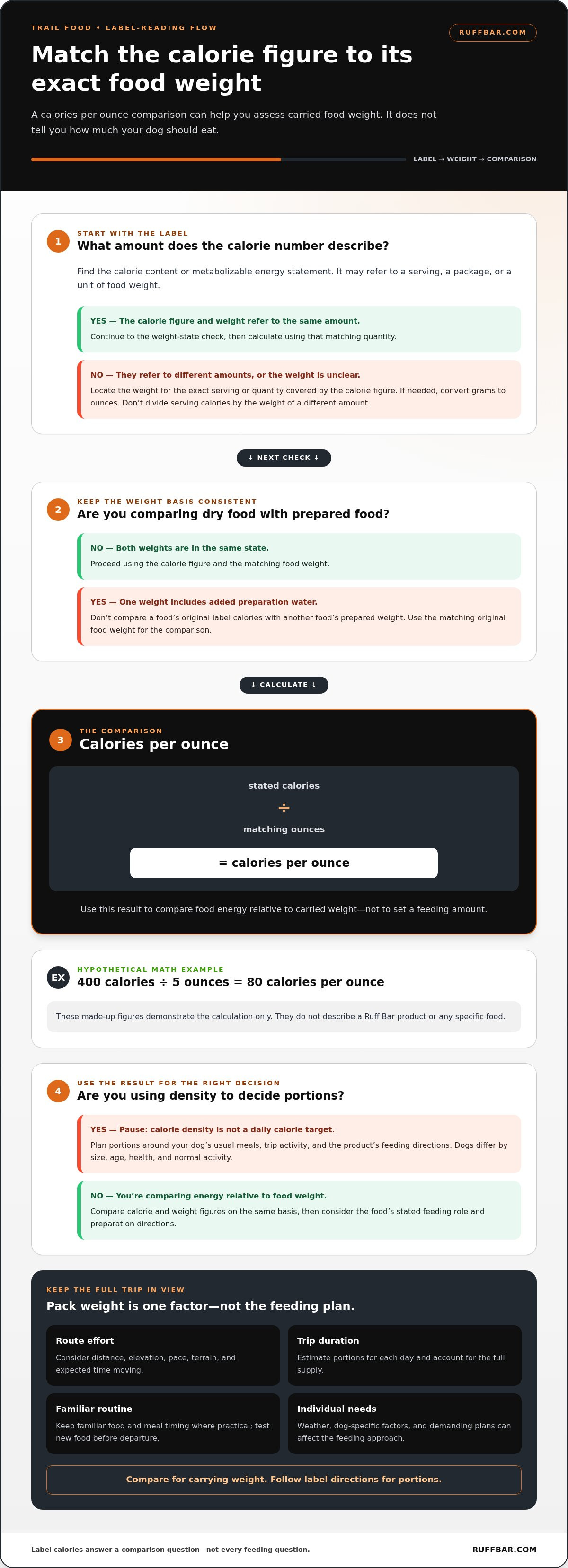
Label comparisons work only when you compare like with like. A calorie figure may describe a serving, a package, or a specific weight of food. Before using it to estimate pack weight, identify exactly what amount the figure covers. This check makes calorie dense dog food travel comparisons more useful without turning a density calculation into a feeding recommendation.
Which calorie number should you compare?
Look for the calorie content or metabolizable energy statement. It may be shown as calories per serving, per package, or per unit of weight. Check the serving size and its weight before comparing products. If one figure describes a single portion and another describes a whole package, convert them to the same basis first.
Also distinguish dry weight from prepared weight. A meal that gains water during preparation weighs more after mixing, but its original label calories shouldn’t be compared with another food’s prepared weight. For context on pet-food standards and labeling, consult AAFCO: Pet Food Standards and Regulations. Label terminology can clarify a food’s intended role, while calorie density helps you compare energy with weight.
Turn label information into a pack-weight comparison
Use the calorie figure and the exact weight it applies to. Convert grams to ounces if needed, and don’t mix a serving’s calorie count with the weight of a different amount.
- Find the calories listed for a specific serving or quantity.
- Find the weight of that same serving or quantity in ounces.
- Divide the stated calories by the matching ounces.
Formula: calories per ounce = stated calories ÷ ounces.
Hypothetical example only: If a made-up food lists 400 calories for a 5-ounce portion, divide 400 by 5. The result is 80 calories per ounce. These sample figures demonstrate the math only; they don’t describe a Ruff Bar product or any specific food.
Use the result to compare food energy relative to carried weight, not to decide whether a food suits your dog or how much your dog should eat. Follow the product’s serving and feeding directions when planning portions. For more context on energy bars and their role, see the high-protein dog energy bars guide.
Keep the comparison practical: align the calorie basis, align the weight basis, then review the label’s intended feeding role. For shelf-stable options to consider for trip planning, explore Ruff Bar’s adventure-focused dog nutrition.
Compare Travel Dog-Food Formats by Calories, Weight, and Feeding Role
The best format depends on more than what fits in a pack. Compare each option by package weight, label calories, preparation directions, and stated feeding role. Then weigh portability against suitability: compact packaging doesn’t tell you whether a food is intended to provide a meal or supplement one. For trip-planning context, see this freeze-dried raw backpacking food guide.
Dry, shelf-stable, and freeze-dried formats on the move
Kibble, shelf-stable meals, freeze-dried meals, and bars can differ in packaging and preparation. Check the label for how the food should be served, whether preparation is needed, and the calories attached to a stated amount. Don’t assume a format has more calories or weighs less. Compare the package and calorie details for the specific products you’re considering.
Water changes the carried load only if you pack it. If label directions call for adding water, account for that water separately when it’s carried with you. Water gathered along the route may not add to the food’s packed weight, but preparation still needs to follow the product directions.
| Format | Package weight | Label calories | Preparation | Stated feeding role |
|---|---|---|---|---|
| Kibble | Record the net weight you’ll carry. | Use the label’s stated calories and matching amount. | Check serving directions; don’t assume preparation is needed. | Follow the label’s intended-use statement. |
| Shelf-stable meal | Compare package weight for the amount planned. | Use the calorie figure tied to the stated serving or package. | Follow any serving or storage directions. | Check whether the label identifies it as a meal or supplemental food. |
| Freeze-dried meal | Compare the package’s carried weight, and account for any separately packed water. | Use the stated calories for the matching food amount. | Follow label directions for serving or preparation. | Use the label’s feeding guidance to determine its role. |
| Supplemental bar | Record the weight of the quantity you plan to pack. | Compare calories for the labeled serving, not an assumed portion. | Check the label for serving directions. | Use as directed; don’t treat a supplement as a meal by default. |
Meals, toppers, and treats serve different roles
A product’s portability and its feeding role are separate questions. Labels may describe food as complete and balanced or as supplemental; use the stated intended use rather than judging by the product’s shape or name. Ruff Food Freeze Dried Raw Backpacking Meals in Beef and Duck are travel-oriented meal formats to assess by their package details and label directions.
Ruff Stix® and Ruff Food Bars are distinct options, not automatic meal replacements. Check each product’s label for its intended role and serving guidance before adding it to your dog’s plan. For calorie dense dog food travel, compare formats using the same measures, then choose the combination that fits your dog’s routine and the trip.
Plan Your Dog’s Travel Food: Portions, Routine, and Pack Strategy
A reliable feeding plan starts with what your dog already eats, not a guess based on trail mileage. Use familiar portions and the food label as your baseline. Then account for trip length, expected activity, and how you’ll carry and serve each meal. A calorie dense dog food travel plan should adapt to your dog and itinerary without treating every outing as a reason to change the diet.
Build a trip-specific food allowance
Write down your dog’s usual daily amount and meal times. Check the label directions for the food you plan to pack, especially if you’re combining a regular meal with another product. Estimate the amount needed for the full trip from those portions, then consider whether longer days or more demanding activity call for a different plan. There’s no universal calorie multiplier that suits every dog.
Before departure, test any new food at home and introduce it gradually rather than making an abrupt switch at the trailhead. This gives you a chance to see whether your dog accepts it and whether it fits the established routine. If your dog has health, weight, or special-diet needs, ask your veterinarian for individualized feeding guidance before changing the travel plan.
Pack for reliable feeding away from home
Set up each day’s feeding before you leave. Pre-portion food where practical, and label portions clearly so you can find the right meal without opening extra packages. Keep feeding times as close to your dog’s normal schedule as the route allows. Pack clean water and plan regular opportunities for your dog to drink. Food does not replace water, including on high-activity days.
Follow the package’s storage directions, especially after opening or preparing food. Keep any utensils or containers needed for serving with the relevant portions. If a product requires water or another preparation step, include that in your camp routine and account for the water separately if you’ll need to carry it.
Build in a sensible buffer for delays or itinerary changes. The right amount depends on the route, resupply options, and how much flexibility you need; avoid relying on a fixed extra percentage for every trip. Keep the buffer accessible, and review the plan before departure so you’re not forced to ration meals if plans shift.
- Usual portions: Record the amount and timing your dog follows at home.
- Trip demands: Note the duration, activity, and likely schedule changes.
- Product directions: Confirm serving, preparation, and storage guidance.
- Water and routine: Plan clean drinking water and familiar feeding opportunities.
- Food trial: Test new options before departure, not during the trip.
With your plan set, explore Ruff Bar travel nutrition for shelf-stable formats to assess by label directions and intended feeding role.
Choose Ruff Bar Travel Nutrition That Fits Your Dog’s Plan
Ruff Bar sells shelf-stable nutrition products for active dogs, including freeze-dried backpacking meals, Stix, and food bars. These formats serve different purposes. Their portability may make them useful to consider for an outing, but it doesn’t make them interchangeable or mean each one is a complete meal.
Ruff Bar’s formulas use USDA-graded grass-fed meats and whole organic ingredients without fillers. For calorie dense dog food travel planning, pair that ingredient information with the practical details that shape your pack: calories, package weight, preparation, and the product’s stated feeding role.
Match the Ruff Bar format to the job
Ruff Food Freeze Dried Raw Backpacking Meals Beef and Ruff Food Freeze Dried Raw Backpacking Meals Duck are freeze-dried meal options for backpacking. Ruff Stix® come in Bison Pork, Beef, and Pork. Ruff Food Bars offer another distinct format to assess. Use each product’s label to understand its intended feeding role rather than assuming a Stix or bar replaces a meal.
Before packing, check the package for calories, serving instructions, preparation directions, and intended use. Those details help you compare the product with your dog’s existing food plan. Don’t estimate servings from the product name, ingredient list, or package size alone.
Make the final choice with the label and your dog in mind
Choose based on the job the food needs to do. Compare calories relative to weight, then consider whether the product’s feeding role fits, how it must be prepared, and how it works with your trip. A light format may simplify packing, but it still needs to fit your dog’s established feeding routine and individual dietary needs.
Use this quick final check before heading out:
- Compare the label: Match calorie information to the food weight it describes.
- Confirm the role: Distinguish meal feeding from supplemental use by reading the intended-use statement.
- Plan preparation: Account for any label-directed steps and what you’ll need to carry.
- Protect routine: Keep familiar food and feeding habits in view, especially if adding a new format.
Read package directions before every outing. Labels guide serving and storage, and product information can change. If your dog has specific dietary needs, include them in the decision rather than choosing on pack weight alone. The right travel setup fits both the route and the dog carrying it.
Build your next trip plan around food formats and label details that suit your dog. Explore Ruff Bar nutrition for the next adventure.
Make the Next Outing a Confident Start
Your next trip is a chance to build a feeding plan that works in real conditions. Before a longer route, try your packing setup on a shorter outing. Notice what’s easy to serve, how well the timing fits your day, and whether your dog settles into the routine. Small adjustments at home can make feeding feel more familiar once the trail begins.
Keep your calorie dense dog food travel plan flexible. Your dog’s needs and the demands of each trip can shift, so let careful observation guide future packing choices. Choose food with purpose, prepare with care, and leave room for the unexpected.
Ready to plan your dog’s next adventure? Explore Ruff Bar nutrition for the next adventure, then make the route your own. Pack well and head out together.
Frequently Asked Questions
How do I calculate calories per ounce in dog food?
Divide the calories listed for a serving by that same serving’s weight in ounces. If the label gives calories per measured serving, use the weight of that serving, not the whole package. Don’t divide calories per cup by package weight, since those figures describe different amounts. This comparison can help assess calorie dense dog food travel options, but it doesn’t set your dog’s daily needs.
Does high-protein dog food always have more calories?
No. A protein percentage or “high-protein” claim doesn’t tell you the calories in a portion. Check the calorie statement and the amount it describes, then consider the food’s intended feeding role. For a travel comparison, note both the calories and the weight of the matching serving. That gives you useful information about the food you’d carry; protein claims alone can’t answer the pack-weight question.
Can I switch my dog to a new travel food right before a hike?
It’s better to introduce a new food before the trip, not for the first time on the trail. Offer it alongside your dog’s familiar food and follow the package directions, giving yourself time to see whether your dog accepts it. Keep normal meal timing as consistent as possible. If your dog has a medical condition, prescribed diet, or digestive history, get your veterinarian’s guidance before making a change.
Is calorie-dense dog food right for every dog?
No. Higher calorie density may reduce the weight of food carried, but it doesn’t mean every dog should eat that food or receive larger portions. A dog’s age, health, body condition, and daily routine all matter. Stick with the established feeding plan unless there’s a clear reason to adjust it. For a dog with weight concerns, a medical condition, or a prescribed diet, ask your veterinarian before changing food or portions.
What should I do if my dog refuses food while traveling?
Offer familiar food in a quiet rest spot and keep clean drinking water available. A new or richer food isn’t a reliable fix for a refused meal, and repeated food changes can make it harder to identify what your dog will eat. Note whether your dog is also refusing water or seems unwell. If food refusal continues or your dog shows concerning changes, contact a veterinarian for advice.
How should I store dog food after opening it on a trip?
Follow the storage directions on the specific package, including instructions for food that’s been opened or prepared. Reseal the original package if its directions allow, or use a clean container that protects the food from moisture and contamination. Keep serving utensils clean, and don’t assume shelf-stable foods all have the same handling needs once opened. Check the label before packing leftovers for the next leg.
How much water should I pack for a dog on a hike?
There’s no single amount that fits every hike. Plan around your dog, the length and effort of the route, weather, and whether dependable clean water is available along the way. Carry enough to cover stretches without a reliable source, and bring a way to offer your dog a drink during breaks. Food calories can’t determine water needs. Ask your veterinarian for a trip-specific plan if your dog has special hydration needs.